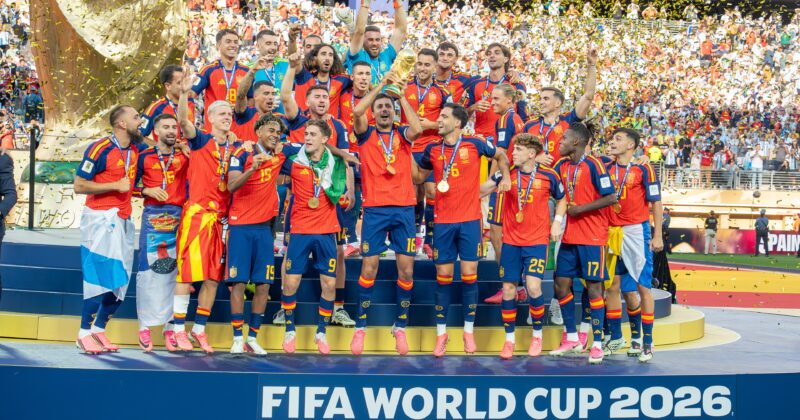
Ninety minutes of the 2026 World Cup final produced nothing. Not a wasted nothing — a tense, gripping, defensively immaculate nothing, Spain camped in Argentina’s half for most of the match, Emiliano Martínez somehow keeping out shot after shot, Argentina barely able to string together an attack of their own. It took until the 106th minute, deep into extra time, for Ferran Torres to settle it, 1-0. Only then did the trophy have anywhere to go.
It’s not the first time a World Cup final has gone this way on American soil. The last genuinely goalless final was USA ’94 — Brazil and Italy playing out 120 scoreless minutes at the Rose Bowl before Roberto Baggio put his penalty over the bar and handed Brazil the trophy on spot-kicks. Different final margin, same essential shape: two elite sides, defensively locked, waiting for one moment to matter more than all the others.
And that, more than anything served up by a 6-4 thriller, is what football actually is.
The Anomaly Is the 6-4, Not the 0-0
A day earlier, England beat France 6-4 in an extraordinary third-place play-off — the most goals scored in a World Cup match since 1982, a genuine ten-goal classic. It was thrilling, and it will be remembered for years. But it was also, statistically and stylistically, an outlier. Two teams with nothing left to play for except pride and farewell moments for their outgoing managers, playing with a freedom and defensive carelessness neither would show in a final. That match will never be confused with how England or France actually set up when the stakes are real.
Walk into any Premier League, La Liga, or Serie A weekend and 0-0 isn’t the exception, it’s a routine, expected outcome. Football, unlike almost any other major global sport, tolerates — even rewards — the possibility that a contest between two well-matched sides produces no goals at all, because the tension, the shifting patterns, the tactical chess match, and the sheer difficulty of scoring are the actual product being sold. The goal is the release valve, not the point.
Why the Stalemate Is the Sport, Not a Flaw In It
This is what gets lost whenever people call for football to be more “exciting” by American commercial standards. The 0-0 exists because football supports an almost unlimited number of legitimate ways to set a team up, and when two of those approaches cancel each other out perfectly, you get nothing — and that nothing is itself the product of extraordinary skill and tactical planning on both sides.
Pep Guardiola’s possession-based tiki-taka and Jürgen Klopp’s gegenpressing heavy metal football are stylistic opposites, built on almost inverse footballing philosophies, and both have won nearly everything there is to win. Sam Allardyce and Sean Dyche’s route-one, set-piece-first, defensively regimented football sits at a completely different end of the spectrum again, and it has kept unfashionable clubs in the top flight for years against sides with vastly bigger budgets. That range — from patient possession to physical directness to disciplined defensive structure — is precisely why football produces the widest variety of match outcomes of any major sport, including matches where the “result” is that nobody could break the other side down at all.
Take that range away, or engineer the game to punish teams for playing defensively, and you don’t get more excitement. You get less football.
Why This Will Never Fully Translate in America
This is, in the end, why football has never quite conquered the US the way it dominates almost everywhere else. American sports culture is built around scoring as entertainment: quarters instead of halves to maximise ad breaks, structured timeouts, a clock that stops constantly to manufacture more moments for the broadcast package, and a cultural expectation that a “good” game is a high-scoring one. Basketball, American football, baseball — all of them are engineered, quite deliberately, to produce frequent, discrete scoring events that translate cleanly into commercial breaks and highlight reels.
Football resists that engineering by design. The clock doesn’t stop for the sport’s convenience. There’s no built-in halftime show slot beyond the one break. And crucially, the sport treats a 0-0 draw between two well-organised sides as a legitimate, sometimes even beautiful outcome, not a failure of the product. You cannot sell that idea to a market that has been trained for a century to expect the scoreboard to move constantly, and no amount of tweaking — bigger goals, shootouts to end draws, timed stoppages — actually fixes that mismatch, because the mismatch isn’t about the rules. It’s about what each culture has decided a “good game” is supposed to feel like.
The 2026 final gave the world a masterclass in exactly what makes football football: two of the best sides on the planet, locked in a genuine tactical struggle, producing precisely one moment of quality across 106 minutes, and settling the entire tournament on it. That’s not a game short of excitement. That’s the sport working exactly as it’s supposed to.