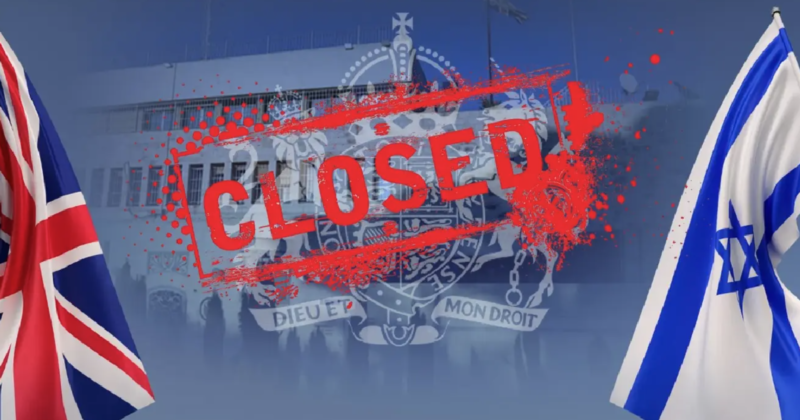
Yesterday, the UK banned the import of goods from Israeli settlements in the occupied West Bank — the most significant tightening of British policy toward Israel in years, with France and Canada announcing similar measures. Foreign Secretary Ed Miliband told Parliament the settlements are unlawful and accused Israel of carrying out “ethnic cleansing.” That’s genuinely strong language for a diplomatic statement.
And yet the same news cycle was immediately layered with something you don’t see attached to sanctions on most other countries: the UK’s Chief Rabbi calling it “a dark day for British Jews,” the opposition’s foreign affairs spokesman warning that “turning Israel into a pariah will risk sectarian division in our own country and risk a further rise in antisemitic violence on our own streets,” and government efforts throughout to stress the action targets Israeli government policy, not Jewish people. Compare that to how sanctions on Russia, India, or Pakistan get announced — a clear statement of the policy and the reasoning, without an accompanying public reassurance campaign about domestic community relations. Why does Israel specifically get this extra diplomatic layer?
The Comparison Isn’t Entirely Clean
It’s worth being fair to the comparison before making the argument, because the “we have no issue with the people” line does exist in UK rhetoric around Russia too — a genuine 2020 parliamentary exchange on the Intelligence and Security Committee’s Russia Report includes the government stating plainly, “we have no issue with the Russian people. It is the Russian state that is involved in a litany of hostile activity.” So the basic instinct to separate a government’s actions from its population isn’t unique to how Britain talks about Israel.
What’s genuinely different, and much harder to find a parallel for with Russia, India, or Pakistan, is the specific, immediate, and prominent linkage to feared domestic backlash against a named UK minority community — invoked by the country’s most senior religious authority for that community and a shadow cabinet minister, within the same 24-hour news cycle as the policy announcement itself, rather than as a background diplomatic footnote.
There’s a Real, Documented Reason This Fear Isn’t Invented
Here’s where the picture gets genuinely more complicated than a simple double standard, and worth taking seriously on its own terms. The Community Security Trust — the organisation that monitors antisemitic incidents in the UK — has recorded a direct, repeated, measurable pattern: antisemitic incidents in Britain spike sharply every time the Israel-Palestine conflict escalates, regardless of what Israel itself has or hasn’t done at that specific moment. Following the 7 October 2023 Hamas attack, antisemitic incidents in the UK rose 147% for the year, reaching over 4,100 — the highest annual total ever recorded, in a series going back to 1984. CST’s own account is direct: the week immediately following 7 October saw 416 incidents, more than any subsequent week, and crucially, this spike began before Israel had even launched any significant military response — meaning the trigger wasn’t Israeli government policy at all, but events happening thousands of miles away being redirected as hostility toward ordinary British Jews. CST’s own summary of the pattern: “when conflict rages in Israel, anti-Jewish hate rises in the UK.”
That’s a genuinely different dynamic from anything documented around UK sanctions on Russia, India, or Pakistan — there’s no comparable, well-established pattern of hate crimes against British Russians, British Indians, or British Pakistanis spiking specifically in response to those governments’ policies making international headlines. If that pattern is real and repeatable — and CST’s data across multiple escalations suggests it is — then a UK minister genuinely concerned about a foreseeable rise in hate crime against an already-targeted domestic community has a real, evidence-based reason to address that risk explicitly, rather than assume the distinction between “Israel the state” and “British Jews” will be obvious to everyone without being said.
But That Doesn’t Fully Explain the Asymmetry Either
Here’s the part worth pushing back on, because the antisemitism data alone doesn’t close the whole gap. Islamophobic hate crime in the UK has also spiked during the same period, driven by the same conflict, and yet government statements on sanctions or policy actions affecting Muslim-majority states don’t tend to receive the same explicit, immediate, high-profile “this isn’t about the community” framing from senior religious or political figures within the same news cycle. If the justification for the extra caveat is purely “conflict-linked hate crime is a real, documented risk,” that risk isn’t exclusive to the Jewish community — it just doesn’t appear to trigger the same reflexive public reassurance ritual when the community at risk is British Muslims instead.
There’s also a structural political factor worth naming plainly: organisations like Conservative Friends of Israel and Labour Friends of Israel have long been among the most well-organised, cross-party lobbying presences in Westminster, giving pro-Israel voices a genuinely embedded seat at the table for any policy discussion touching Israel in a way few other single-country lobbies in British politics can match. That’s not a conspiracy, it’s simply organised political advocacy doing what organised political advocacy does — but it’s a real, additional factor in why any UK government announcement on Israel arrives pre-wrapped in more anticipatory political management than a similar announcement on almost any other country.
The Honest Answer
There isn’t a single, clean explanation, and pretending otherwise would be dishonest to the genuine complexity here. Part of the answer is a real, well-documented, repeatable pattern of antisemitic hate crime spiking in the UK whenever the Israel-Palestine conflict escalates — a legitimate concern for any minister to want to head off explicitly. Part of it is that the exact same courtesy doesn’t appear to extend as visibly to British Muslims facing a comparable pattern of Islamophobic backlash over the same conflict, which suggests the caveat isn’t purely a function of measured risk. And part of it is simply that Israel has a more organised, higher-profile lobbying and advocacy presence in British politics than Russia, India, or Pakistan currently do, which shapes how carefully any government statement gets pre-managed before it’s delivered. All three of those things can be true simultaneously, and probably are.