By Furkan Jussab | News & Politics
Picture it the way most of us first learned how teams get picked. Two captains, standing in front of a crowd of kids in a park or a school playground, taking it in turns to call out names. A handful of players get picked in the first round without any hesitation — everyone already knows which side they’re on before a single name is called. Then you get to the middle of the crowd, and it slows down. Some kids are good enough that both captains want them. Some kids have a mate on the other team and don’t want to be the one who ends up facing them. Some kids just don’t want to play at all.
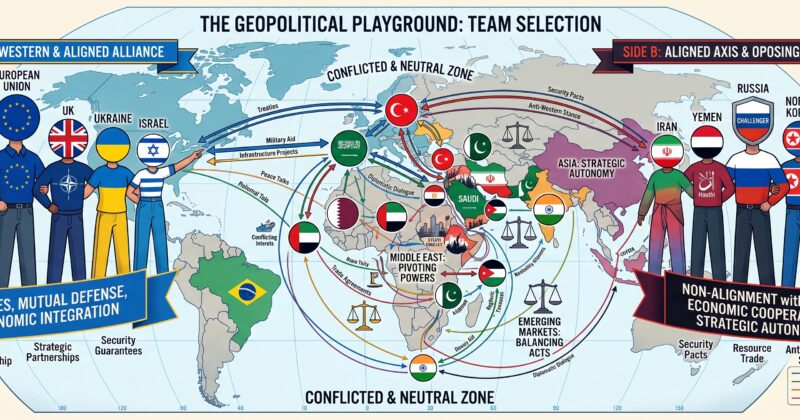
That’s roughly where the world is right now, if the conflicts I’ve written about over the last two pieces keep escalating the way the evidence suggests they will. There are two captains. There’s a first round of names that get called without any argument. And then there’s a much longer, much messier list of countries whose loyalties aren’t nearly as simple as the map makes them look.
Let’s go through the picking order properly.
Round One: The Names Called Without Hesitation
Side A is the US, the European Union, the UK, NATO as a bloc, Ukraine, and Israel. This is the coalition that’s been forming in practice for years now — Ukraine fighting Russia with Western weapons and Western money, Israel fighting Iran and its proxies with American backing, and NATO as the connective tissue that turns “the West supports Ukraine” and “the West supports Israel” into one overlapping alliance structure. None of this needs much unpacking. It’s the position every one of these countries has already publicly and repeatedly committed to.
Side B is Iran, the Houthis in Yemen, and Russia. Also not controversial to state — these are the three actors currently on the other end of Western and Israeli military action, either directly or through the proxies they fund and arm.
Then there are two more names I think belong in Side B’s column, even though neither one is fighting on the ground yet.
North Korea already has a live, ratified mutual defence treaty with Russia, signed in June 2024, which commits both sides to “immediately provide military and other assistance” if either is attacked. This isn’t a hypothetical alignment — North Korean troops are already fighting for Russia in Ukraine. If Russia is a combatant, North Korea already is too, in practice, on that front at least.
China is the one I want to spend a moment on, because I don’t think it belongs anywhere near the “neutral” column anymore, and you were right to push back on that framing. Officially, Beijing has declared neutrality throughout the Iran war. In practice, Chinese firms have supplied Iran with missile components, radar systems, navigation equipment, satellite reconnaissance imagery, and — according to multiple reports — have routed man-portable air defence systems to Iran through third countries, with Iran reportedly acquiring several hundred Chinese-made units this way. China has also abstained rather than opposed at the UN Security Council whenever a resolution has gone against Iran, while vetoing alongside Russia when a proposal looked unbalanced against Tehran. That’s not fence-sitting. That’s picking a side and being careful not to say so out loud, largely because well over 80% of Iran’s oil exports go to China, and China has no interest in a Hormuz shutdown or a regime change that puts a more Western-aligned government in Tehran. Quiet backing is still backing.
So Side B, properly drawn, is Iran, the Houthis, Russia, North Korea, and China.
Round Two: The Conflicted Picks
This is where it gets genuinely complicated, and where I think the real story of this war — if it becomes one in the fullest sense — actually lives.
Saudi Arabia. The obvious pick is Side A. It’s the country whose oil infrastructure has just been attacked, and it has deep security, economic and diplomatic ties to the US. But it cannot afford to look publicly aligned with Israel while Gaza remains the defining issue across the Arab and Muslim world — normalising with Israel right now would be a serious domestic and regional liability for Riyadh, whatever quietly happens behind closed doors. And Saudi Arabia is now bound by treaty to Turkey and Pakistan under the Mecca Joint Defence Agreement, signed 7 August 2026 — a genuine NATO Article 5-style pact where an attack on one signatory is treated as an attack on all three, with Saudi arms funding it, Turkey supplying the military technology, and Pakistan supplying personnel. That pact was built with Iran in mind as the likely trigger. It complicates the idea that Saudi Arabia is simply “with the West.”
Turkey. NATO member. Also a Mecca pact signatory alongside Saudi Arabia and Pakistan. Also a country whose president has been one of the most vocal state critics of Israel’s conduct in Gaza anywhere in the world, and whose public would not accept a government seen fighting alongside Israel. Turkey sits in the genuinely uncomfortable position of being formally inside the Western alliance structure while its regional defence pact and its domestic politics both pull it away from Israel specifically.
Pakistan. A nuclear-armed state that’s now treaty-bound to defend Saudi Arabia and Turkey — but has a consistently warm, cooperative relationship with Iran, including energy cooperation and a shared border it has no interest in destabilising. If Iran becomes the actual target of a war that pulls in Saudi Arabia under the Mecca pact, Pakistan is put in the position of being contractually obligated to a side fighting a country it doesn’t consider an enemy.
Qatar. Possibly the single most conflicted actor on this entire list. It hosts Al Udeid, the largest US military base in the Middle East. It also shares the South Pars/North Dome gas field directly with Iran and has historically hosted Hamas’s political office. Whatever Qatar’s government actually wants, geography and economics have wired it into both sides simultaneously.
The UAE. Signed the Abraham Accords with Israel in 2020, which nominally places it closer to Side A than almost any other Gulf state. But it has spent the current conflict actively working to de-escalate rather than get pulled further in, aware of exactly how unpopular visible alignment with Israel is on its own streets and across the region.
Egypt and Jordan. Both hold formal peace treaties with Israel dating back decades, and both cooperate closely with the US militarily. Both are also under serious domestic pressure over Gaza, with public anger that limits how openly pro-Israel either government can afford to be seen. Egypt has also been named as a country in talks to potentially join the Mecca pact, which would add another layer to its position.
Oman. Runs what it calls “active neutrality” — a genuine friends-to-all, enemies-to-none policy shaped by decades of serving as a back-channel between Iran and the West. That neutrality has already been tested directly: Iranian drones struck the Omani port cities of Duqm, Salalah and Sohar in March 2026, killing civilians, and both Tehran and Muscat moved quickly to downplay the incident rather than let it become a rupture. Oman hosts US military assets while depending heavily on trade with Iran — its ports have seen exports rise 117% since the war began, giving it a direct financial incentive to stay out of it entirely.
Bahrain. Has taken a more openly US-aligned posture than Oman, declining to even participate in an Iranian-proposed meeting over the Strait of Hormuz. Geographically and politically it’s closer to Side A, but as a small Gulf state sitting just off the Iranian coast, it’s acutely exposed if this escalates.
Iraq. The government itself has tried to stay neutral, condemning strikes on its territory from any direction and insisting it won’t let its soil be used as a launchpad against Iran. But that neutrality doesn’t hold on the ground. Iranian-backed militias operating inside Iraq — Kata’ib Hezbollah and others under the “Islamic Resistance in Iraq” banner — have carried out sustained drone and missile campaigns against US facilities and the US Embassy in Baghdad, at one point claiming responsibility for targeting 27 US military bases across the region in a single 24-hour period. Iraq is less a country choosing a side than a battlefield the sides are fighting on regardless of what its government wants.
Syria. Under its post-Assad government led by Ahmed al-Sharaa, Syria has explicitly declared it will remain outside the conflict unless directly attacked, with al-Sharaa saying the country has had fourteen years of war and knows exactly why peace matters more than participation. Syria has simultaneously been pursuing quiet, direct talks with Israel toward some kind of security arrangement, while distancing itself from Iran’s old regional network. A genuinely new and different position from the Assad-era alignment with Tehran.
Lebanon, via Hezbollah. Historically Iran’s most capable regional proxy and a core part of what’s been called the “Axis of Resistance.” Substantially degraded by Israeli operations over the past two years, and under real domestic and international pressure to disarm before Lebanon’s 2026 elections — but not eliminated, and still capable of destabilising the country. Lebanon as a state doesn’t want this war. Hezbollah as an armed faction inside it may not get a vote in the matter.
India. Rarely discussed in this context, but genuinely one of the more conflicted major powers. Close defence, trade and technology ties to both Israel and Russia simultaneously — an alignment most countries can’t sustain but India has managed for years — plus its own investment in Iran’s Chabahar port as a trade route that bypasses Pakistan entirely. India has every reason to want this contained rather than resolved in either direction.
Azerbaijan. Deep defence and energy ties to Israel — it’s one of Israel’s largest oil suppliers and arms customers — alongside a close cultural and political relationship with Turkey, and a more complicated history with Russia. Another state genuinely pulled in more than one direction at once.
Hungary, inside the EU. Worth naming specifically because “the EU” isn’t actually one voice on Russia the way it presents itself as being. Hungary has repeatedly broken from the rest of the bloc on Russia-related votes and sanctions, which matters if this becomes a question of EU unity rather than just NATO unity.
What This Actually Tells Us
Line it up and the picture is this: two blocs with genuinely settled positions — the US-EU-UK-NATO-Ukraine-Israel side, and the Iran-Houthi-Russia-North Korea-China side, the latter more honestly described than the “China is neutral” framing usually allows. And then a long list of countries — Saudi Arabia, Turkey, Pakistan, Qatar, the UAE, Egypt, Jordan, Oman, Bahrain, Iraq, Syria, Lebanon, India, Azerbaijan — each with a genuine, specific reason they can’t simply slot into either team the way the simple version of this map suggests.
That messiness isn’t a side detail. It’s the actual story. Most of the countries that would matter most if this widens are not choosing between right and wrong, or even between two abstract global blocs. They’re doing what nearly every country in history does when a war escalates around it: weighing treaty obligations against public opinion, energy interests against military alliances, and old loyalties against new ones, all at the same time, often without a clean answer.
That’s the governments’ calculation. What I want to look at next is a different question entirely — not what these governments have decided, but what the actual people living in these countries want to happen next, and how far that lines up with the positions their leaders are taking on their behalf. That’s the next piece.
Have I missed a country that belongs on this list? Tell me who, and which side you think they’d actually end up on.