By Furkan Jussab | Sport
I’ve deliberately sat on this one. The verdict against Manchester City dropped at the end of September and within days there were a hundred articles and a thousand videos all saying roughly the same things, from roughly the same angles. I didn’t want to add another voice repeating the obvious points. I’ve now read and watched enough of it, and I think there’s a version of this story that isn’t being told properly, so here it is.
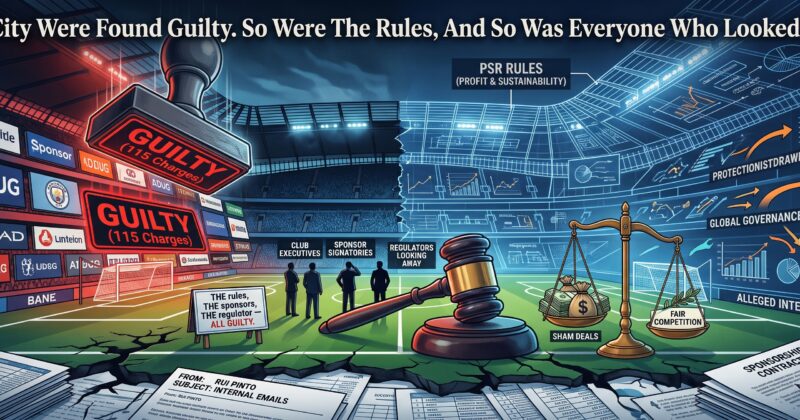
The headline is straightforward enough on its own. Manchester City were found guilty on 114 of the 115 charges brought against them by the Premier League — the single charge they escaped was eventually also found against them on review, so in practice it’s all 115. The sponsorship charges specifically found that City arranged fake commercial deals where sponsors only paid a portion of the fee actually recorded, with the rest quietly topped up by Abu Dhabi United Group (ADUG), the club’s owner, so the accounts showed the sponsorship as far bigger and more legitimate than it actually was. The commission also found a “sham circular arrangement” through an entity called Fordham, which acquired players’ image rights and was itself funded by ADUG. In total, the ruling found over £830 million in secret Abu Dhabi funding dressed up as sponsorship income. City say they’re “disappointed and surprised,” have called the findings “unsafe,” and are appealing. Their CEO, Ferran Soriano, dismissed the whole thing as a “Premier League conspiracy theory.” That’s their right, and until that appeal is resolved, City remain, in the eyes of the law, not yet finally sanctioned.
That’s the version everyone’s covered. Here’s the part I don’t think has been covered properly.
Why Did It Take a Hack?
The central piece of evidence underpinning this entire case didn’t come from a Premier League audit. It came from a hack. Rui Pinto, the Portuguese hacker behind Football Leaks, obtained and published the internal emails that first exposed how City’s sponsorship arrangements actually worked, years before any of this reached a Premier League commission. Without that leak, there’s no reason to believe any of this comes to light at all.
Which raises the question nobody in power wants asked directly: why did it take a criminal hack to find what a regulator is supposed to be actively looking for? Manchester City’s sponsorship income ballooned to figures that dwarfed historically bigger clubs — Manchester United, Liverpool — at a point when City had none of the footballing success that would normally justify that kind of commercial pulling power. That’s not a subtle anomaly buried in a spreadsheet. That’s the kind of thing that should have triggered scrutiny on its own, long before a hacker did the Premier League’s job for it.
So either the Premier League genuinely didn’t notice a club’s sponsorship income detaching itself from every normal commercial logic for years on end, or it noticed and chose not to look too closely. I don’t think there’s a comfortable answer between those two. And it matters because the Premier League takes a direct financial cut from the broadcasting and commercial success of its member clubs — the bigger and more “successful” City looked, the more valuable the competition’s own product looked to broadcasters. There is a real, structural incentive for the Premier League not to go digging too hard into exactly how a member club is funding its rise. Plausible deniability is cheap when you’ve simply chosen not to look.
It Takes Two To Fake A Contract
Here’s the point I haven’t seen made anywhere else. A sponsorship contract has two signatories. Manchester City is one party to every one of these sham deals. The sponsor is the other. These are public, named commercial agreements — and if the figures were fabricated or inflated, that is not a fact City alone control. The company on the other side of the contract knew exactly what it was signing, and knew exactly how much of that fee was real.
So why is the conversation entirely about Manchester City’s guilt and not a word about the sponsors who went along with it? If a company signs a contract overstating the value of what it’s actually paying, in order to help a football club disguise where its real money is coming from, that company has participated in exactly the same deception. Where is the list of every sponsor named across these 115 charges? Why is there no suggestion any of them face so much as a review of their other sponsorship arrangements in football, let alone a ban? If the guilt is real, and the Premier League’s own commission says it is, the guilt doesn’t start and stop at the club. Everyone who signed their name to a sham arrangement carries some part of that.
The Premier League’s Own Inconsistency
There’s also the question of pace, and the Premier League doesn’t come out of this well either. Everton and Nottingham Forest were docked points within weeks of their breaches being confirmed, over sums that are a rounding error next to what’s alleged against City. Chelsea self-reported historic financial irregularities under their previous ownership and quietly settled with a fine, no points deduction, barely registering as a story. City’s case has run for years, survived multiple delays, and the Premier League still hasn’t confirmed the actual sanction a month after the guilty verdict. If the Premier League wants credibility as a regulator rather than a business protecting its most valuable product, it needs one standard applied at one speed to everyone. It currently doesn’t have that, and that inconsistency is itself a failure of governance, regardless of what happens to City on appeal.
The Rules Themselves Aren’t Clean Either
Now here’s where I think the conversation needs to get uncomfortable in a different direction, because both of these things are true at once: City broke rules they agreed to, and the rules themselves are built to protect exactly the clubs that didn’t need protecting.
The Premier League’s Profit and Sustainability Rules tie what a club can spend to the revenue it already generates. On the surface that sounds reasonable. In practice, it entrenches whichever clubs already have the biggest global commercial reach — Manchester United, Liverpool, Arsenal — because their revenue is a function of decades of accumulated history, fanbase and international television reach that no new owner can simply buy their way into quickly. Newcastle United’s Saudi-backed ownership and Aston Villa’s American ownership have both been visibly constrained by PSR, unable to spend at the level their actual owners could afford, because the rules tie spending to revenue the club hasn’t built up yet. That’s not a hypothetical complaint — pundits including Alan Shearer have said exactly this about Newcastle specifically.
Compare that to how clubs used to break into the elite. Jack Walker took control of Blackburn Rovers in January 1991, when they were a Second Division club, and personally spent around £25 million on players in his first three years alongside more than £20 million rebuilding the stadium and training facilities. Blackburn won the league in 1995 — their first top-flight title in 81 years. Newcastle’s rise in the early-to-mid 1990s under Sir John Hall’s investment followed a similar pattern: an owner’s own money, put directly into a club, built it from the Second Division into a genuine title challenger within a few years. Under the current rules, neither of those stories could happen today. An owner wanting to do exactly what Walker and Hall did — invest heavily to build a club up from nothing — is now blocked by regulations that didn’t exist when the traditional “big clubs” built their own advantage the exact same way, just a generation earlier.
So yes, City signed up to PSR and then broke it, and that’s genuinely wrong — agreeing to a rule and then circumventing it in secret isn’t the same complaint as the rule being unfair, and I’m not using one to excuse the other. But it’s also fair to ask whether the rule they broke was ever a level playing field in the first place, or whether it was designed, consciously or not, to lock in the advantage the historic clubs already held.
Is It Even The Same Rules Everywhere?
And that question gets sharper once you look outside England. Germany’s Bundesliga runs the 50+1 rule, which requires members — effectively fans — to hold a majority stake in a club, deliberately preventing the kind of single wealthy owner model the Premier League allows outright. It’s a completely different philosophy of ownership, built specifically to stop what happened at City or Newcastle from happening in Germany at all.
France operates its own financial oversight through the DNCG, and yet PSG — majority owned by Qatar Sports Investments — has operated for years under exactly the kind of state-backed spending model City have now been found guilty of disguising. La Liga president Javier Tebas has spent years publicly accusing both PSG and Manchester City of “financial doping,” arguing they’ve been laughing at Financial Fair Play while his own league enforces a hard spending cap tied to actual revenue on every one of its clubs, Real Madrid and Barcelona included. If Tebas is right that PSG have operated with the same disguised state funding model City have just been found guilty of, then this isn’t a Premier League problem. It’s a pattern repeating itself with different leagues choosing to look away at different speeds.
Which brings it to UEFA, and the most serious allegation in this entire saga that’s had almost no attention next to the City verdict itself. Rui Pinto — the same hacker whose leaks exposed City’s sponsorship arrangements in the first place — has directly and repeatedly accused Gianni Infantino, in his role as UEFA’s general secretary at the time, of abusing his authority to shield both Manchester City and PSG from the consequences their financial conduct should have carried. Pinto’s allegation is specific: that when both clubs faced a genuine threat of Champions League bans in 2014 over inflated sponsorship arrangements, Infantino personally intervened to steer UEFA’s investigatory process away from serious punishment and toward fines instead, calling Infantino “a cancer on football” as a result. Infantino is now FIFA president. If that allegation is accurate even in part, the person now running world football’s governing body was, at a formative moment, the one making sure state-backed financial doping carried no real consequence.
Both Things Are True
Manchester City broke rules they agreed to, using sham contracts that a regulator should arguably have caught years before a hacker did it for them, with sponsors who signed their name to the deception and have faced no scrutiny at all. The Premier League has been wildly inconsistent in how fast and how seriously it treats different clubs’ breaches, likely because it profits from exactly the kind of commercial inflation it’s now punishing. And underneath all of it, the rules themselves were built in a way that locks today’s elite in place while blocking the exact path — a wealthy owner’s direct investment — that built that elite’s advantage in the first place a generation ago, a path other leagues regulate completely differently, and a path the man now running FIFA has been directly accused of quietly protecting when it suited the state-backed clubs doing it.
None of that makes City innocent. It makes almost everyone else in this story guilty of something too.
Where do you land on this — is PSR a legitimate rule City broke, or an unfair rule dressed up as fairness? Let me know in the comments.