By Furkan Jussab | News & Politics
Following on from the last piece, I want to make an argument I think a lot of Western politicians either don’t understand or don’t want to say out loud. I’m deliberately leaving the US out of this one — I think it’s long established itself as a warmongering country and that’s a separate conversation. I’m talking about the rest of the West here: the UK, and Europe.
Every Western country I can think of is currently gripped by the same two domestic arguments. Oil and energy prices making everyday life harder. And immigration. Turn on any news channel in any Western country and those two topics dominate the discussion, usually framed as if they’re separate issues with separate causes.
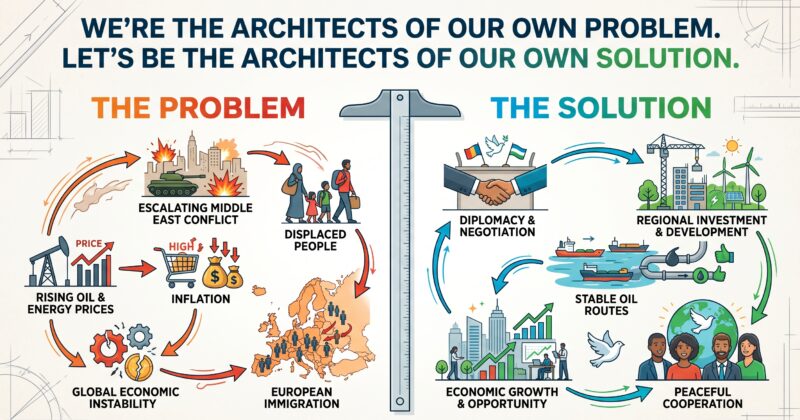
They’re not separate. They’re the same issue, wearing two different faces, and it’s a face of our own making.
What Escalating These Wars Actually Does
Look at what happens, historically, every single time a war breaks out or escalates in the Middle East. During the 1973 oil embargo, the price of oil nearly quadrupled — from around $2.90 a barrel to $11.65 within months. When the Iranian Revolution hit in 1979, prices more than doubled again within a year. The 1990 Gulf War produced another sharp spike. This isn’t speculation on my part. It’s the documented pattern, every time, for fifty years running.
So when I look at what’s unfolding right now — Saudi Arabia’s oil routes compromised, Yemen’s war set to escalate, Iran on its highest alert, the signs of a wider regional conflict building — the honest prediction isn’t complicated. Oil prices go up. When oil goes up, the cost of transporting goods goes up, the cost of manufacturing goods goes up, and that feeds straight into the inflation that’s already squeezing people in every Western country. The oil price argument and the cost of living argument are the same argument.
Then there’s the second half of it. War displaces people. That is not a theory, it’s the most consistent pattern in modern history. The Syrian civil war alone has forcibly displaced over 13 million people, with more than 6.7 million forced out of the country entirely. Roughly half a million of them reached Europe in just the second half of 2015, arriving faster than any European system was built to process. Libya’s collapse after the 2011 intervention did the same thing on a smaller scale. Iraq’s did too. Every time the West has helped tip a Middle Eastern country into prolonged war, a wave of displaced people has followed, and a chunk of that wave has ended up trying to reach Europe, because Europe is close, and because Europe spends a great deal of time and money broadcasting its own prosperity and freedoms to the rest of the world.
That’s the part I think gets missed constantly in the immigration debate. Nobody leaves a stable, functioning country in large numbers to risk a small boat crossing. People leave when the alternative is bombs, siege, starvation, or a economy that’s been flattened by years of conflict. If we escalate wars that flatten those economies and destroy that stability, we are not a passive bystander to the immigration wave that follows. We are one of its authors.
So What’s The Alternative?
Here’s where I think the argument actually needs to go, because criticism without an alternative isn’t worth much.
The alternative is diplomacy and investment instead of escalation and bombing. Work with Middle Eastern governments directly. Broker the conflicts between them rather than picking a side and arming it further. Where there’s genuine instability, invest in rebuilding rather than adding to the rubble.
What would that actually achieve, in practical terms? If Saudi Arabia’s oil infrastructure isn’t under attack, the pipeline keeps flowing, and oil prices stay closer to where they are now rather than spiking. If Yemen isn’t dragged into a wider war, that’s fewer displaced people with a reason to move. If regional economies are being invested in and stabilised rather than bombed, fewer people are forced to leave their homes to survive, and fewer still are drawn toward the countries the West has spent decades telling the world are the promised land of freedom and opportunity. You can’t spend seventy years exporting the idea that the West is where you go to build a better life, then act surprised when people in destroyed countries try to come here.
This isn’t a naive argument about the West suddenly becoming saints. It’s a self-interest argument as much as a moral one. Every pound spent helping stabilise these regions is a pound that isn’t spent later on emergency fuel subsidies, asylum processing, cross-Channel enforcement, or the political fallout from all three. Prevention is cheaper than the clean-up, every single time, and we keep choosing the clean-up.
We Don’t Get Weaker By Helping People Up
There’s a mentality running underneath all of this that I think is worth naming directly: the idea that helping other countries prosper somehow weakens our own position, while keeping them dependent, unstable, or contained somehow strengthens it.
I think that’s backwards, and I think it costs more than it saves. It takes far more energy, money, and political capital to keep a country down — through sanctions, proxy conflicts, propping up convenient regimes, occasional airstrikes — than it would to genuinely help that country stand on its own feet. One of those paths produces a stable trading partner who has less reason to send its oil prices spiking or its citizens fleeing. The other produces exactly what we’re watching unfold this week.
We built the version of the world we’re currently living in. Decades of intervention, regime change, and unresolved conflict in the Middle East didn’t happen to us — it happened because of choices Western governments made, repeatedly, often in service of short-term strategic or economic interests. We are, in a very real sense, the architects of the problem we now spend our news cycles complaining about.
So let’s actually be the architects of the solution instead. Not through more bombs, and not through more of the wars I described in the last piece continuing to escalate unchecked — but through the boring, unglamorous, genuinely difficult work of diplomacy and investment. It won’t make headlines the way an airstrike does. But it’s the only version of this that actually fixes the two things every Western voter says they’re angry about, instead of making both of them worse.
Is this too idealistic, or is it the only argument that actually holds up? Let me know what you think in the comments.