
By Furkan Jussab | Technology
Nobody serious doubts the technology. I’ve written about AI many times on this site, about what it can do, what it’s costing us, and where it might take us. The question I want to ask today is different, and it’s the one the markets have started asking in the last fortnight: can anyone make money from it, and if they can’t, what happens to the improvements?
I had this piece ready to publish when the market gave it a third chapter. I’ve added it below, and it changes my argument a little.
The Fortnight Before
China. Chinese AI stocks have crashed. The STAR50, an index of Chinese AI and semiconductor leaders, fell around 40% in under four months, which one analysis puts at roughly $480 billion of lost value. Bloomberg reports that the two listed Chinese model labs, Zhipu and MiniMax, have together shed about $150 billion from their highs. Zhipu is down around 81% from its June peak, and MiniMax fell below its IPO price on 22 October, wiping out a 650% gain from March. There was no single trigger. The reasons cited are sky-high valuations, worries about demand, US export controls, and a crackdown on leverage in Beijing. But the effect is clear: the most optimistic AI stocks in the world’s second-largest economy have been marked down hard.
The tech rout. On 15 October a global tech sell-off hit Nvidia, AMD and Dell, with headlines pinning it on “AI funding worries.”
Google. Then came Alphabet’s results on 28 October. Revenue was $127.6 billion, up 25% but slightly short of what analysts expected. Capital spending more than doubled to $51.4 billion in a single quarter. Free cash flow was negative $9.1 billion, after Alphabet’s first-ever negative quarter in the one before. The next day the shares fell about 13%, wiping out roughly $500 billion of market value in one session. Reports describe it as the company’s worst day ever, beating the 11.6% fall in March 2020. CNBC reported that Alphabet held its 2026 spending forecast unchanged while signalling a significant increase in 2027, and that Microsoft also put off raising its own estimate.
None of that says the technology doesn’t work. It says investors have started to ask when the money comes back.
Then This Week Added a Different Question
On Tuesday 3 November, Americans voted, and Democrats won both the House and the Senate. On Wednesday the markets cheered. The Dow rose 1,569 points, or 3%, which Fortune reports was its best performance after a midterm election in 44 years, and the relief was that a divided government limits policy shocks.
On Thursday it reversed. According to Fortune, around $3 trillion of US stock market value was lost at one point in the day. By the close, the Nasdaq was down about 5.5%, the S&P 500 about 4.4% and the Dow about 3.4%, according to the closing figures I found, which come from a financial news site and not from the exchange. The Associated Press called it Wall Street’s biggest one-day decline since April 2025. The Philadelphia Semiconductor Index fell around 12%, Nvidia about 9% and AMD about 17%. An analyst at Capital Economics called it the market’s worst day since the April 2025 tariff shock.
On Friday there was a partial rebound. As I write this, US markets haven’t closed yet, so these are late-session figures. The Nasdaq was up between 1% and 1.5%, the S&P 500 up about 0.6% and the Dow roughly flat. The chip index had recovered about 4% and Nvidia a few per cent, but the week still looks like a loss for all three indexes. It wasn’t only a Wall Street event either. Japan’s Nikkei and South Korea’s benchmark each fell around 6% on Friday, Taiwan’s fell as much as 8% at one point before trimming its losses, and Europe’s STOXX 600 lost about 1.4%.
There was also a reminder that money matters alongside politics. US employers added 165,000 jobs in October against forecasts of around 65,000 to 70,000, and unemployment fell to 4.1%. The 10-year Treasury yield rose to about 4.86%, and reports said a Federal Reserve rate rise in December was back in play. Dearer money on the same day as a political shock is exactly the combination my argument is about.
Not everyone thinks the sell-off was justified. Yardeni Research called it an overreaction and a buying opportunity, describing the political backlash as “speed bumps, not roadblocks.” That may prove right. I’m not trying to call the bottom, and one good Friday doesn’t settle it either way.
The explanation most outlets reached for wasn’t about money. It was about permission.
Data centres use huge amounts of land and electricity, and voters have started pushing back. One tracker cited by Al Jazeera counted voters backing restrictions in 39 of 45 data-centre ballot measures. Fortune counts 41 measures, most of which passed, so I’d say only that restrictions won in the large majority. In Texas, the Democrat Gina Hinojosa, who supports an immediate moratorium on new data centres, beat the governor, Greg Abbott. Wells Fargo estimates that 27% of the planned US data-centre capacity, measured in gigawatts, sits in Texas. UBS estimated that construction pauses could put about 30% of the capacity additions planned for 2028 at risk. That is a possible loss, not one that has happened. Fortune also notes that Abbott had already paused new grid connections in September, so part of that freeze predates the vote.
Before I lean on that explanation, some honest caution.
- The market rose 3% the day after the election. If the result were the clear cause, Wednesday should have gone the other way. And a pre-election report said prediction markets had already rated a Democratic sweep the most likely outcome, so it wasn’t a surprise.
- Other things happened that day. Qualcomm and Arm fell on weak earnings, Tesla and SpaceX fell for their own reasons, and one Swissquote analyst described a wider rotation out of US tech, not just AI policy risk.
- The experts disagree. Capital Economics said whether the midterms derail the AI boom “remains to be seen”. Before the vote, analysts expected state and local decisions, not national laws, to matter, and one wealth manager said policy uncertainty would “disrupt the timing and the cost” without ending the theme.
My reading is that an expected result knocking 5% off the Nasdaq suggests the market was already nervous, which fits everything that has happened since mid-October. The election supplied the headline. Friday’s partial rebound doesn’t change that reading, because one day’s bounce neither confirms the worry nor ends it.
The Size of the Bet
Put the numbers next to each other and you see why nerves are fraying.
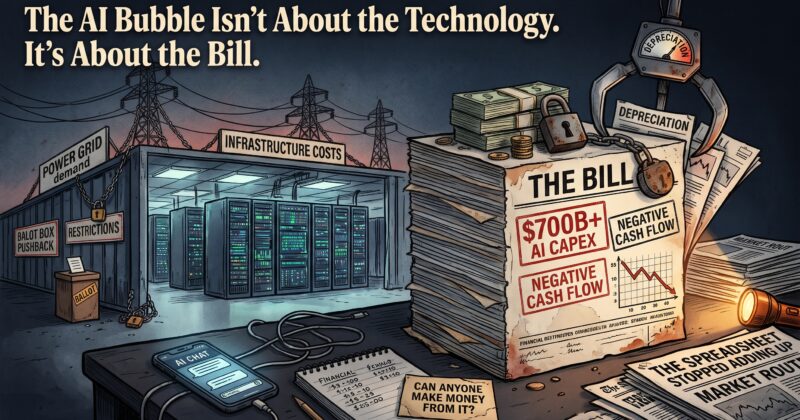
According to Forbes, the four biggest US spenders (Amazon, Microsoft, Alphabet and Meta) are planning roughly $700 to $725 billion of AI-related capital spending in 2026. That is up about 75% on the record $410 billion they spent last year, and the article notes it will consume nearly all of their operating cash flow. Amazon alone is guiding to about $200 billion. Depreciation on all that kit hits the profit and loss account straight away, while the revenue it’s meant to earn arrives later, if it arrives. Moody’s has warned that the spending could put pressure on the credit quality of major tech firms.
The labs themselves are worse off. OpenAI reportedly burned around $3.7 billion in the first quarter of 2026 on revenue of about $5.7 billion, according to documents shared with its shareholders, with both figures roughly tripling in a year. And Anthropic, which confidentially filed for a stock market listing on 1 June and is widely expected to list, has been reported by Axios to have posted roughly $16.3 billion of revenue and a net loss of around $80.7 billion in the first half of this year. I’d treat those figures with caution. The revenue number comes from a single report, I haven’t seen the filing itself, and a loss of that scale may include accounting items that aren’t cash. The reported valuation from its last funding round, about $965 billion, makes the point anyway: investors are being asked to pay for revenue that doesn’t yet exist.
On timing, Reuters reported in late October, citing sources, that Anthropic was aiming for a listing in mid-November, with marketing to investors starting the week of 9 November. The same sources cautioned that the dates could change. It also reported that other AI infrastructure listings, including Switch, Nscale and SB Energy, had been postponed, and that rising interest rates were adding to the sell-off in AI operators’ shares and bonds. Reuters cited investors who thought Anthropic could be worth as much as $1.5 trillion, and a lower-quality crypto news item put the target as high as $2 trillion. I haven’t found anything since this week’s sell-off confirming that the listing has been delayed or is going ahead, and I haven’t seen the filing, so treat all of it as reported, not confirmed.
But the Demand Is Real
I want to be fair, because “bubble” is a lazy word if it ignores what’s actually selling.
Microsoft’s AI business passed a $37 billion annual revenue run rate this year, more than double a year earlier. Azure grew 48%. Google Cloud’s contracted backlog has grown past $460 billion. Companies are signing up. People are using these tools every day. This is not a story about technology nobody wants.
And there’s a paradox inside it. The price of using AI has been falling fast, as labs compete on price. That is good for customers and good for adoption, but reports this summer describe a squeeze on margins for the very companies selling it. When the cost per unit falls faster than the volume rises, you can have a hugely popular product and still struggle to make a profit.
History is a useful, if imperfect, guide. The railways were real, and so were the fibre-optic cables laid in the dot-com boom. Both changed the world. Many of the investors who paid for them lost everything. A technology can be transformative and the companies financing its first phase can still be wiped out. Those are two separate questions, and the market is only now separating them.
Is Cost a Hurdle to Improvement?
This is the part I find most interesting, and I think it gets overlooked.
The leading AI labs are spending billions on each new generation of model, and the next generation costs more again. That only works while somebody keeps paying. Today it’s paid for out of the cash piles of the biggest tech companies, from funding rounds at near-trillion-dollar valuations, and, increasingly, from borrowing. If the cash flows stay negative, the share prices keep falling, and the IPO window narrows, then the money for the next generation gets harder to find.
I wrote recently about the argument that AI progress needs to be paced, that someone should slow the frontier down. There are good safety arguments for that. But the cruellest irony would be if the brake turned out to be money. Not regulation, not ethics, not a deliberate pause, but a spreadsheet that stopped adding up. That wouldn’t be a decision anyone took. It would just happen.
There are reasons not to be too gloomy. Efficiency keeps improving, and smaller, cheaper models keep getting better, which means progress doesn’t depend only on ever-bigger spending. The biggest firms can afford to lose money for a long time. And China’s crash is partly a story of companies with no other business to fund their losses, unlike a giant that can cross-subsidise.
Where I Land
I don’t think the technology is the bubble. I think the bubble, if there is one, is the assumption that the money would arrive on schedule. This week suggests a second assumption was baked in as well: that permission and power would arrive on schedule too. Building these data centres needs capital, land, grid connections and local consent. Capital has been getting dearer for a fortnight. The rest is now politically contested.
And the reason it’s contested is one I keep meeting elsewhere. In a Reuters/Ipsos poll cited before the vote, 69% of Democratic registered voters backed limits on data-centre building, against 43% of Republicans. Many people worry about what these buildings do to their electricity bills, and people who have watched their bills climb are being asked to host them. That is the cost of living, arriving in the AI debate by a side door. I’ll be writing about energy bills shortly, and I suspect the two stories are closer than they look.
The last three weeks show the assumption being tested in real time, in Shanghai, in Mountain View, on trading floors worldwide and now at the ballot box.
What worries me isn’t that AI disappears. It won’t. What worries me is that it gets squeezed into the hands of the few companies that can afford to lose billions for years, while everyone else’s progress stalls. A correction might even be healthy. But if cost becomes the hurdle, then the decisions about how fast AI improves will be made by balance sheets, not by anyone who’s thought about where we want it to go.
Do you think this week was the start of a bubble bursting, or a political shock the market will absorb? Let me know in the comments.