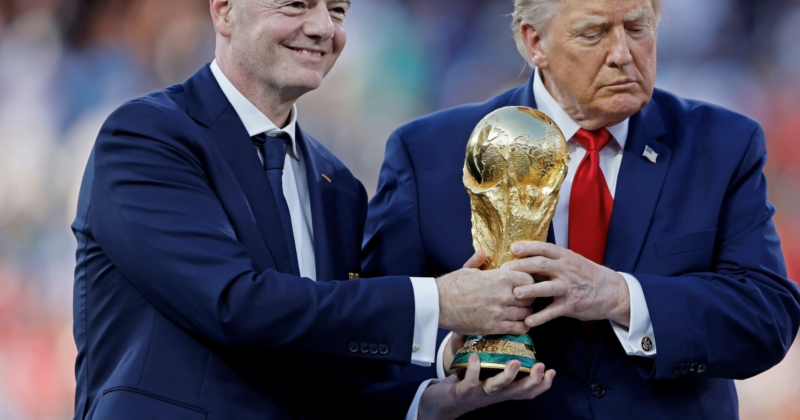
Gianni Infantino’s plan to sell part of FIFA to private investors is dead. What’s left behind is more revealing than the plan itself: an organisation where the president can lose the confidence of his own continent, face open accusations of deception from his own staff, and still walk into next March’s election as the overwhelming favourite to win a fourth term.
The Collapse, in Real Time
The FIFA Forward Enterprise plan — a $20 billion commercial subsidiary that would have sold a stake worth up to $4.2 billion to private investors, anchored by Joshua Kushner’s Thrive Capital — was shelved in the early hours of Saturday 1 August 2026, after a week of escalating revolt. UEFA led it, threatening a full boycott of FIFA competitions if the plan proceeded, and has since gone further: FIFA has now been formally warned that UEFA is “actively considering legal action, arbitration, and/or regulatory complaints,” with lawyers ordering Infantino and FIFA to preserve every document and piece of electronically stored information connected to the scheme. UEFA’s public statement didn’t hold back: “We cannot keep going on like this with secret schemes on fast-track timescales, cooked up by faceless individuals and of dubious benefit to the game. We must identify those responsible and hold them to account.”
The internal picture is just as damning. Senior adviser Carlos Cordeiro resigned over the plan. FIFA’s own chief operating officer, Kevin Lamour, said Infantino had “deceived” FIFA staff over what was actually being proposed. Wales became the first member association to formally withdraw its support for Infantino’s re-election; England’s FA is following, preparing a letter withdrawing its backing and calling for a “full and robust review” of his leadership. New UK Prime Minister Andy Burnham called him simply “the wrong man” to lead FIFA.
Why He’ll Almost Certainly Survive Anyway
Here’s the part that should trouble anyone hoping this actually changes something: none of it may matter. Infantino’s opposition is concentrated almost entirely in Europe, North America, and Asia’s confederations. His support base — Africa, built over a decade through development funding that’s kept smaller federations financially dependent on FIFA’s goodwill, and South America, whose CONMEBOL president wants Infantino’s help expanding the 2030 World Cup to 64 teams specifically to hand his own country, Paraguay, more hosting fixtures — remains largely intact. FIFA runs on one-country-one-vote, and the confederations objecting loudest simply don’t control enough votes on their own to remove him.
This is, almost exactly, a repeat of 2016. Weeks into his presidency, Infantino declared FIFA’s post-Blatter corruption crisis “over,” only for audit and compliance chairman Domenico Scala to resign in protest the same week, over a rule change that gave Infantino’s own council the power to fire the independent officials investigating corruption claims — including, potentially, claims against Infantino himself. Scala called it something that “destroys a substantial achievement” of FIFA’s reforms. It didn’t cost Infantino his job then, and the underlying voting mathematics that protected him then are exactly what protects him now.
The Deeper Problem: A “Charity” Built Entirely Around Money
Step back from Infantino personally, and the more damning conclusion is structural: FIFA is legally a non-profit association. In practice, it now behaves like one of the most aggressively commercial organisations in global sport — chasing private equity deals, expanding tournaments purely for broadcast inventory, and building an entire private-sector partnership around a sitting US president’s son-in-law’s brother, all while its actual stated mission — developing and governing the sport for its 211 members — gets steadily less attention than the next revenue mechanism. Nothing about the FFE plan was about players, fans, or the game itself. It was about money, dressed in the language of “development funding.”
The World Cup Hosting Process Tells the Same Story
If you want to see how thoroughly money and politics have replaced merit in FIFA’s biggest decisions, look at who’s actually been awarded the World Cup, and who’s been rejected.
England, the country that invented the game, has hosted exactly once, in 1966. Its bid for 2018 was eliminated in the very first round of voting, with just two votes — beaten out by Russia, a country whose winning bid, alongside Qatar’s successful 2022 bid, became the subject of a criminal investigation that produced the US Department of Justice’s 2015 indictment of fourteen FIFA officials over decades of bribery tied to media and marketing rights. Qatar hosted in 2022 despite average July temperatures of 46°C, forcing the tournament’s first-ever move to winter. Saudi Arabia was confirmed as host of the 2034 tournament after being the sole bidder — Australia, the only other realistic candidate, withdrew days after the bidding window opened, and the “vote” that followed was a Congress “acclamation” rather than any genuine contest. The United States, by contrast, has now hosted in 1994 and again in 2026 as a co-host, with Mexico becoming the first three-time host across 1970, 1986, and 2026.
That’s the honest scoreboard: countries with the money, political leverage, or willingness to play FIFA’s commercial game get repeated hosting opportunities or effectively uncontested bids; the country that founded the sport has been rejected every time it’s tried for a second turn, including in a vote later found to sit inside a wider web of bribery allegations.
A Better System Isn’t Hard to Imagine
None of this is inevitable. FIFA’s current bidding process — competing full proposals, secretive Executive Committee votes, envelopes of influence trading behind closed doors — is precisely the mechanism that’s produced decades of corruption allegations, from the 2015 indictments back to the 1990s. A genuinely fairer alternative isn’t complicated: identify five credible candidate nations per confederation on a fixed rotation, invite each to present a feasibility case openly, and have FIFA work directly and transparently with those candidates on infrastructure, cost, and legacy planning before any vote — rather than a single secretive congress choosing a “winner” from competing bids assembled behind closed doors, in a process that’s produced a criminal indictment, a winter World Cup in the desert, and a sole-bidder “acclamation” inside the space of two decades.
That kind of reform would need exactly the sort of unified confederation pressure that’s just failed to remove Infantino over a $20 billion private equity scheme. If UEFA, the English FA, and Infantino’s other critics can’t dislodge him over this, it’s hard to see where the leverage for genuine structural reform of the entire hosting process is supposed to come from instead.