A decade ago, doing what I’ve done over the last year would have required a team. A website needs a developer and a designer. A steady stream of published articles needs researchers and writers. A card game needs a designer, a rules editor, artwork. A SaaS product idea needs its own development team entirely. Realistically, getting all of that off the ground at once would have meant hiring somewhere in the region of fifteen different specialists, or finding an agency willing to take it on, at a cost way beyond what makes sense for a side project.
I’ve built all of it largely on my own, using AI as the execution engine, while still working full-time as a Cutover Manager and serving as a magistrate. That’s not a boast. It’s the actual, lived case study behind the argument I want to make: AI didn’t just make my life easier. It let one person do what used to require an office of people.
I’m the Anomaly, Not the Model
Here’s the part I want to be upfront about before going any further, because it’s the difference between an honest piece and a self-congratulatory one: I’m not the norm here, and I’d be kidding myself to write this as though everyone could or should be doing what I’m doing.
Most people, and I mean the actual majority of people in work, are not wired for this kind of creative overload, and there’s nothing wrong with that. Most people want a job that’s stable, that they’re good at, that ends at five o’clock, and that they can leave at the office door. Nine-to-five, clock in, do the job well, go home, live the rest of your life. That’s not a lack of ambition. It’s a completely reasonable, completely valid way to want to exist. The “everyone should become a one-person start-up” framing that a lot of AI commentary leans on is, frankly, a bit delusional about how most people actually want to live. I happen to sit outside that camp. That doesn’t make my camp bigger than it is.
So the more useful, more honest question isn’t “should everyone build their own empire like this.” It’s: what does AI actually do for the person who has no interest in building an empire, and just wants their comfortable, contained job to stay comfortable?
The Comfortable Job Has Two Very Different Futures
And here’s where it gets genuinely complicated, because both of the following things are true at once, for the exact same kind of job.
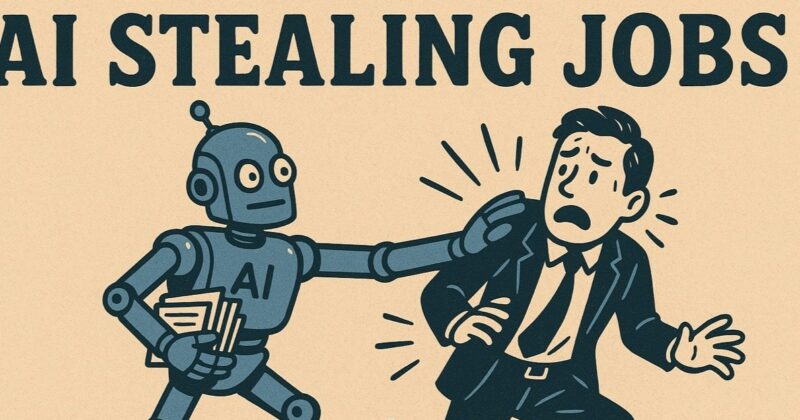
AI can replace a comfortable role. If a company looks at a team of ten doing steady, well-understood, repeatable work and sees an opportunity to do the same output with six people and a set of AI tools, that’s a real, live decision being made in boardrooms right now, and it’s not going away.
But AI can also make that same comfortable role easier, lighter, and arguably more secure, for the person actually doing it, if it’s handed to them properly. The research backs this up more clearly than the doom headlines usually suggest. PwC’s 2026 Global AI Jobs Barometer, drawing on over a billion job postings globally, found that jobs classified as “augmented” — where AI supports a person’s existing work rather than replacing whole tasks — are growing faster than jobs classified as “automated,” with wages in the most AI-exposed roles growing roughly twice as fast as in less-exposed ones. Boston Consulting Group’s own research puts job displacement at a real but comparatively modest 10-15% over the medium term, against a much larger chunk of jobs — over half — being reshaped rather than eliminated, with genuine productivity gains showing up specifically where companies redesign a role around a person working with AI, rather than simply using it to justify a smaller headcount.
That’s the entire tension in one place: the exact same technology, applied to the exact same comfortable job, can either quietly disappear it or quietly make it better. The determining factor isn’t really the individual worker’s ambition or adaptability at all. It’s whether the organisation they work for treats AI as a way to help its people, or as a reason to need fewer of them.
It’s Not Doom, and It’s Not Utopia
I don’t want to hand the comfortable-job majority a falsely rosy story here, because the risk is real and it’s not evenly distributed — some sectors and some roles are genuinely more exposed than others, and no amount of positive framing changes that for the person whose specific job is the one that gets automated away. But I also don’t want to hand them a doom story, because for a great many people in exactly that kind of role, the actual experience of AI arriving in their workplace is going to be a tedious task getting faster, a report writing itself in a fraction of the time, a repetitive piece of admin quietly disappearing from their day — not a redundancy letter.
My own situation proves AI can be a genuine multiplier for someone willing to direct it across a dozen different ambitious things at once. It doesn’t prove that’s the only, or even the main, story worth telling. For most people, the real question isn’t “how do I become a one-person empire.” It’s “is the place I work choosing to use this thing to help me, or to need less of me” — and that’s a question about corporate choices and leadership, not about how ambitious or adaptable any individual worker happens to be.