Sepp Blatter ran FIFA from 1998 to 2015, stepping down amid a corruption scandal so severe it triggered a US Department of Justice indictment, a Swiss criminal investigation, and allegations that reached into sexual misconduct as well as financial rot. He is, by any reasonable measure, one of the least credible people on earth to lecture anyone about football’s integrity. On 28 July 2026, he did it anyway — posting that his successor Gianni Infantino’s relationship with Donald Trump had “reached a financial dimension that is deeply damaging” football, adding “no one has the right to sell our game.” One fan’s reply captured the moment perfectly: “we need you back Sepp. Your corruption was hidden much better.”
That a man banned from football for corruption is now the one sounding the alarm tells you everything about where FIFA has arrived under Infantino.
What Actually Just Happened
The immediate trigger is a plan revealed this week to create FIFA Forward Enterprise, a new $20 billion commercial subsidiary that would take over running FIFA’s money-making operations — broadcast rights, sponsorship, ticketing, licensing for the World Cup and Club World Cup — with a 20% stake sold to private investors. Leading that investor group: Thrive Capital, the fund run by Joshua Kushner, brother of Jared Kushner, Donald Trump’s son-in-law. FIFA is being advised by J.P. Morgan on the deal.
UEFA’s response was immediate and blunt: “It is not FIFA’s to sell. None of us are the owners of football.” New UK Prime Minister Andy Burnham went further: “Football does not belong to investors. It belongs to the people who fill the stands and who stand on the touchline week in, week out, rain or shine.” US congressional Democrats called it “more oligarch corruption,” pointing to FIFA’s use of dynamic pricing during the 2026 World Cup, which pushed ticket prices to unprecedented levels for ordinary fans.
Here is the part that should stop anyone defending this as normal business: FIFA is legally a Swiss-based, not-for-profit association. It exists, on paper, to develop and govern the sport for the benefit of its 211 member federations, not to generate shareholder returns for private equity. A not-for-profit selling a fifth of its commercial operations to a fund with a direct family connection to a sitting US president isn’t a governance innovation. It’s a nonprofit deciding to start acting like a business while keeping the tax and regulatory advantages of pretending it isn’t one.
How Infantino Can Actually Get Away With This
This is the mechanism worth understanding, because it explains everything else. FIFA runs on a one-country-one-vote system: 211 member federations, each with equal voting power, regardless of whether that federation is England or San Marino, Brazil or Samoa. Europe generates the overwhelming majority of football’s actual commercial value but controls just 55 of those 211 votes. The numerical majority sits with smaller federations — many in Africa, Asia, and the Caribbean — that depend heavily on FIFA’s development funding to survive.
Infantino has spent a decade methodically strengthening exactly that dependency. Development funding to smaller associations has increased steadily since his 2016 election, and the current private equity plan follows an identical playbook on a larger scale: member federations are being offered up to $20 million each in one-off capital if they approve the deal, against a smaller $10 million if they reject it. For federations that will never realistically qualify for a World Cup and depend on FIFA for survival, that’s not a hard choice, whatever Europe thinks of the deal’s merits.
Infantino cemented control over internal accountability early. In 2017, he moved to give FIFA’s own council — which he chairs — the power to fire members of FIFA’s independent ethics and audit committees. Audit chairman Domenico Scala resigned in protest, calling it a “power grab” that “destroys a substantial achievement of the reforms” built after the 2015 scandal. Two committee members investigating complaints involving Infantino himself were sidelined in the same period. The independent oversight built specifically to prevent another Blatter-style crisis was dismantled by the man who promised, on his way into office, to be the reformer.
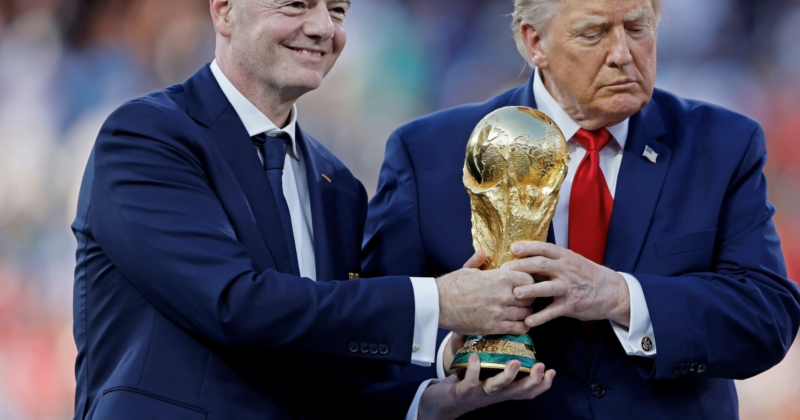
And then there’s the political proximity. Infantino created a brand-new “FIFA Peace Prize” and awarded its first-ever edition to Donald Trump. When American striker Folarin Balogun was suspended during the 2026 World Cup, Trump called Infantino directly, and within hours FIFA suspended the ban — “I’m the one that got them to do it,” Trump said publicly. Former BBC presenter Gary Lineker dubbed Infantino “Gianni Sycophantino.” None of this is subtle. It’s a president who has built a governance system where the people who could hold him accountable either depend on his money or have had their power stripped, while cultivating the most powerful individual government relationships available to insulate whatever comes next.
Players, the Game, and Fans — All an Afterthought
None of this is separate from questions of welfare, because governance capture is precisely why welfare keeps losing. FIFA under Infantino has expanded the World Cup from 32 to 48 teams, created an expanded Club World Cup squeezed into an already packed calendar, and introduced mid-match “hydration breaks” during the 2026 tournament that functioned, transparently, as extra advertising windows rather than genuine player welfare measures. Global players’ unions have spent years warning that fixture congestion is pushing elite players toward burnout and injury, warnings that have had essentially no effect on a calendar that keeps expanding in exactly the direction that generates more broadcast inventory to sell.
Fans have fared no better. Dynamic pricing during the 2026 World Cup pushed tickets to levels ordinary supporters increasingly can’t afford, while corporate hospitality packages expanded. The pattern across players, match integrity, and fan access is consistent: whenever growth and welfare conflict, growth wins, because growth is what generates the revenue that keeps smaller federations dependent and the president in power.
This Isn’t New. It’s the Pattern Repeating
None of this is a departure from FIFA’s history. It’s a continuation of it. In May 2015, the US Department of Justice indicted fourteen FIFA officials and marketing executives over a 24-year scheme involving $150 million in bribes tied to media and marketing rights. Jack Warner, then a FIFA vice president, was separately accused of taking a $10 million bribe in exchange for backing South Africa’s 2010 World Cup bid. Most vividly: in May 2011, at a meeting in Port of Spain, Trinidad, Qatari official Mohamed bin Hammam’s presidential campaign saw Caribbean Football Union officials handed brown envelopes stuffed with $40,000 in cash, caught partly through witness testimony from a Bahamas football official who reported it. Bin Hammam received a lifetime ban; Warner resigned rather than face FIFA’s own investigation. The bidding processes that awarded the 2018 World Cup to Russia and the 2022 tournament to Qatar were both engulfed by the same criminal investigations.
Infantino was elected in 2016 specifically as the reform candidate meant to end this era. A decade on, the mechanism has changed — private equity and presidential phone calls rather than brown envelopes — but the underlying dynamic of money buying influence over the sport’s governance hasn’t gone anywhere.
Could the UN Actually Take This On?
It’s a genuinely interesting proposal, and worth testing honestly rather than dismissing outright. The appeal is obvious: an intergovernmental body with genuine legal standing, existing outside any single football confederation’s commercial interest, could in theory offer the kind of independent oversight FIFA’s own ethics committees have twice now failed to sustain.
The practical obstacles are severe, though. FIFA is a private Swiss association, not a public body — the UN has no legal mechanism to simply assume control of it any more than it could assume control of any other private international organisation, without FIFA’s own 211 members voting to hand over power, which is precisely the vote Infantino’s structure is built to prevent. The UN also has no existing sports governance apparatus, no comparable revenue base (FIFA alone made an estimated $15 billion from the 2026 World Cup cycle), and would need to build enforcement powers and technical football expertise from scratch. A more realistic version of the same idea might be an independent international treaty body, sitting alongside the UN rather than inside it, with binding authority over specific issues, host-nation human rights conditions, and financial transparency — closer to how the World Anti-Doping Agency operates across multiple sports today, rather than a full takeover of football’s governance entirely.
Boycott, or Business as Usual
UEFA does have one genuine lever it’s used before: in 2021, European-led opposition helped kill Infantino’s plan to hold the World Cup every two years instead of four, largely through the credible threat of a continental boycott. The same tool is being discussed again now. Whether it actually happens is another question — Europe holds only 55 of 211 votes, and every previous attempt to check Infantino’s power through FIFA’s own democratic structure has run into the exact same wall: the numbers were never built to favour the people with the leverage to actually stop him.