By Furkan Jussab | News & Politics
Before I start, a word on tone. I’m not trying to be a doom-monger. I’m writing down what I see, as an outsider looking at the pieces on the board, and I want to be honest about where my evidence is strong and where it isn’t.
Over the past few months I’ve published a run of articles that, read together, build a picture. In We’re in World War Three, It Just Hasn’t Been Labelled That Yet, I argued that the conflicts we call “regional” are linked far more closely than the labels suggest. In Nuclear Weapons Will Be Used Again: This Isn’t Fear-Mongering, It’s Where the Evidence Points, I looked at the rising chance that someone, somewhere, uses one. Then came If This Becomes the War We Think It’s Becoming, Who’s Actually on Which Side? and The Governments Have Picked Sides. Their People Are a Different Story, which mapped the alliances and the public mood. And last week, Are the Governments Secretly Preparing for a Perfect Storm of Disasters? asked why so many governments are suddenly telling their citizens to stock up.
I wrote those as an outside perspective, almost a blueprint. This week, two elections have made me think the timeline might be shorter than I assumed. This piece is about those two elections. A second piece, tomorrow, covers a set of other events from the same few days.
Where the Iran War Stands Right Now
It’s easy to lose track, so here is the position as of today.
The war began in late February. A Pakistan-brokered ceasefire took effect on 8 April, and the US announced a naval blockade of Iran on 13 April. The Strait of Hormuz has been effectively shut to Western-allied shipping for months. Talks have been going on indirectly, with Qatar passing proposals back and forth. Iran has offered to reopen the Strait within two days if the US meets seven conditions, including lifting sanctions and ending the blockade. On Tuesday, Iran’s Supreme National Security Council secretary said Washington’s reply fell short.
It is not a clean ceasefire either. In the early hours of Tuesday, the US struck Iran’s Qeshm Island, near the Strait. US officials called it “defensive,” following Iranian fire at an American aircraft. Trump confirmed it and called it a “minor attack” that “wasn’t war,” adding that further action would come “if we have to.” US media also reported that Central Command had strike plans ready that could begin as early as Wednesday. I want to be clear that this is reporting, not confirmation that any order has been given.
That is the backdrop: a war that’s neither finished nor fully fighting, with a blockade, a closed waterway, and a deal both sides say they want but haven’t signed.
Leader One: Trump
Democrats have won both the House and the Senate. That makes Trump the first Republican president to lose both chambers in a midterm since George W. Bush in 2006, and before that Eisenhower in 1954. It’s a heavy defeat by any measure.
And the war was a big part of it. Trump himself said as much to Fox, “I think a part of it was Iran,” though he also argued that fuel prices hurt Republicans more than the war did. He told the Wall Street Journal he would do it again. In other words, the voters rejected the war and the president’s public response is that he stands by it.
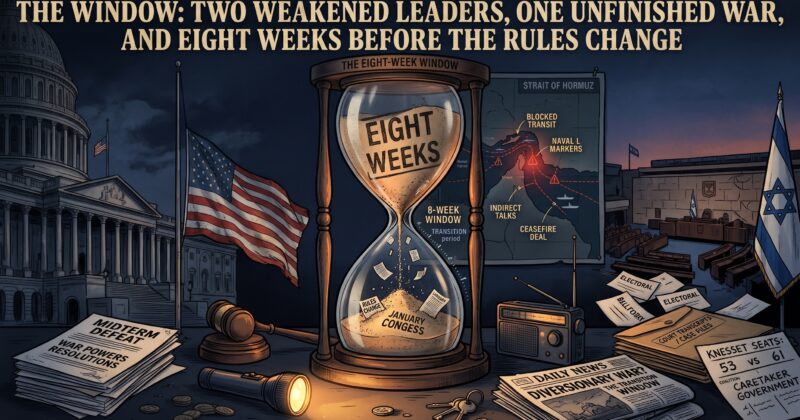
Here is the point I keep coming back to. Whatever the new Congress does, foreign policy is the area where a president has the most freedom to act. Democrats do have tools. They can push war powers resolutions, hold hearings, issue subpoenas and try to cut funding. But they lack the two-thirds majority needed to override a veto, and there is a precedent from 2007, when Democrats took Congress, Bush vetoed a withdrawal deadline, and they ended up passing the war budget anyway. The new Congress takes its seats in January. Until then, the president has fewer checks on him than he will have for the rest of his term.
Analysts, including commentators quoted in Iranian outlets, argue exactly that: that the two months before the new Congress arrives is the period of greatest risk. I’d note that source is not neutral, and it is an argument, not a prediction. Trump has also said that Washington has no immediate plans for another major attack, and that indirect talks over enriched uranium are continuing.
Leader Two: Netanyahu
Israel’s election on 27 October produced something just as unresolved. Likud won 27 seats, the most of any party. But Netanyahu’s bloc has 53, eight short of the 61 needed for a majority in the 120-seat Knesset. The opposition bloc has 48 and the Arab-led parties 19, so no side has a majority. Gadi Eisenkot’s Yashar party is the biggest in the opposition bloc and a real alternative.
Here is what happens next. The new Knesset is sworn in on 10 November. President Herzog must choose someone to try to form a government by 11 November. That person has 28 days, extendable by 14. If they fail, someone else gets a turn, and if nobody succeeds, the Knesset is dissolved and a new election follows within 90 days. Through all of it, Netanyahu remains caretaker prime minister, which could last months.
Does being a caretaker stop him acting militarily? Legal analysis says not really. A caretaker government is not barred from going to war, and the law treats it the same as an ordinary one on that point. A war decision needs the government or the Security Cabinet, not the prime minister alone, and a caretaker is expected to show restraint on anything not urgent or irreversible. But as the same analysis notes, the more essential an action is deemed, the less restraint is expected.
There is also the personal angle, which I’ll state carefully. Netanyahu is on trial for bribery, fraud and breach of trust, which he denies. He asked for a pardon in November 2025, and President Herzog said in April that a plea deal should be pursued first. Holding the prime minister’s office matters enormously to someone in that position. I’m not saying that drives his decisions. I’m saying it is part of what he has at stake in how the next few months go.
The Argument, and Its Limits
Put the two together and here is my reasoning. Two leaders, each with a weakened mandate. Both have a war that’s already running and an adversary in the same place. Both have a stretch of weeks where their formal constraints are loosest. And there is a long-standing theory in political science, “diversionary war,” which says leaders in trouble at home sometimes escalate abroad. The evidence for it is mixed, and I don’t want to oversell it.
There are serious reasons it might not happen:
- The voters have just said no. Americans rejected the war at the ballot box, and Trump has acknowledged it was a factor. Escalating immediately after would be an act of defiance.
- Israelis are tired. The polling I covered earlier showed a majority still backing the fight against Iran, but with falling confidence and social cohesion. A rally effect isn’t guaranteed.
- The deal is still alive. Both sides are exchanging proposals. A signed memorandum would change everything.
- No public evidence of intent. The legal analysts I read say explicitly that there’s no public evidence that Israel’s government is planning a war for political reasons. I haven’t found any either.
So I’m not predicting that either leader will escalate. My claim is narrower. The incentives, the opportunity and the timing all point in the same direction at the same moment, and that is worth watching rather than ignoring.
What Would Tell Us I’m Wrong
I think any argument like this should say what would count against it. Here’s what I’ll be watching:
- A signed deal on Hormuz. If the Strait reopens and the blockade ends, the risk falls sharply.
- Herzog’s choice on 11 November, and whether a coalition of any colour forms quickly. A stable government makes a caretaker-period gamble less likely.
- Congress. Whether war powers or funding measures start moving, and whether the president responds.
- Oil and shipping. A calm Hormuz is a sign of de-escalation. Another tanker incident is the opposite.
- Any statement from either leader that rules out new strikes, as opposed to saying they “have no immediate plans.”
If most of those go the right way over the next eight weeks, I’ll happily say I was wrong to worry.
If they don’t, then the question is no longer whether these pieces fit together, but what comes next. That’s for the third article in this series. Tomorrow’s piece looks at the other events from this week, including the fake nuclear alerts, the hacked fridges, and a television drama whose fictional strike on Kaliningrad drew a nuclear warning from the Russian embassy.
Do you think a weakened leader is more likely to escalate, or less? Let me know in the comments.