The idea that nuclear weapons are a settled, backseat issue — invoked mainly as a pretext for stopping certain countries acquiring them, rather than a live, rising risk in their own right — doesn’t survive contact with where things actually stand right now. Every major indicator that experts use to measure this risk has moved in the same direction over the last two years: closer.
This isn’t a piece about which country is the villain. Several nuclear-armed and nuclear-adjacent states have all, independently, pushed the world nearer to actual use over the past eighteen months. The pattern matters more than any single actor’s motives.
The Clock Everyone Should Be Watching
Every January, the Bulletin of the Atomic Scientists — founded by Manhattan Project physicists in 1945, guided today by a board that includes eight Nobel laureates — sets the Doomsday Clock, a symbolic measure of how close humanity sits to global catastrophe. In January 2026, it was set at 85 seconds to midnight. That’s the closest it has ever been in the Clock’s 79-year history, four seconds closer than the previous year’s already-record setting. Among the specific reasons cited: the New START Treaty, the last major agreement capping US and Russian nuclear arsenals, expired on 5 February 2026 with nothing negotiated to replace it. As the Bulletin’s own science board chair put it, “for the first time in over half a century, there will be nothing preventing a runaway nuclear arms race.”
That’s not campaign rhetoric from either side of any political divide. It’s the settled judgement of the scientists who have run this exact assessment since the Cold War began.
The Testing Taboo Is Already Breaking
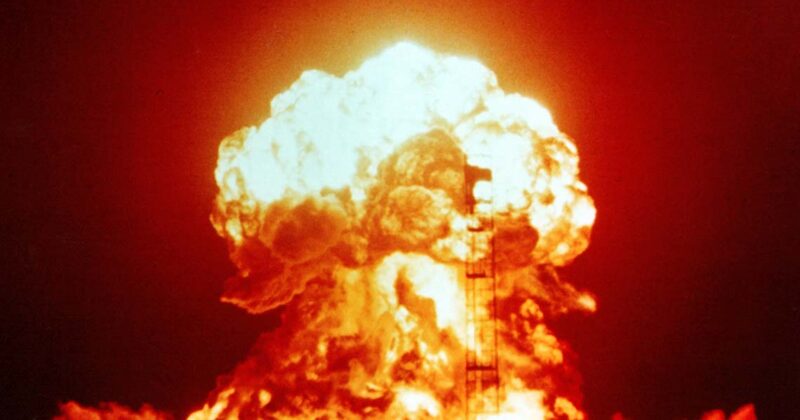
For over thirty years, actual nuclear test detonations have been treated as a line nobody credible crosses — the US hasn’t conducted one since 1992, Russia since 1990, China since 1996. Only North Korea has broken that norm this century. In October 2025, that changed. President Trump instructed the Pentagon to resume testing “on an equal basis” with Russia and China, citing Russian tests of new nuclear-capable delivery systems, including an underwater drone designed to trigger a tsunami and a nuclear-powered cruise missile Putin himself described as having unlimited range. Putin responded within days by ordering Russian officials to draw up their own proposals for resuming test detonations, while stating Russia had, until that point, honoured its test-ban commitments. Arms control experts on both sides warned the exchange risked “a chain reaction of nuclear testing” that could unravel the non-proliferation framework built since the 1960s. Whatever the underlying intent on either side, the practical effect has been to make actual weapons testing — not just rhetoric — a live policy option again, for the first time in a generation.
South Asia Came Closer Than Most People Realised
In May 2025, India and Pakistan fought what analysts at the Stimson Center call only the third serious, deadly direct military engagement between two nuclear-armed states in history — after Sino-Soviet border clashes in 1969 and the 1999 Kargil War, which involved the same two countries. Triggered by a militant attack in Kashmir that killed 26 civilians, the four-day conflict saw India suspend the Indus Waters Treaty, a water-sharing agreement that has survived every prior India-Pakistan war since 1947, precisely because Pakistan’s downstream water supply is considered close to an existential issue for the country. Pakistani officials have repeatedly, publicly indicated nuclear weapons remain on the table if the country’s survival is threatened; Indian officials maintain a no-first-use doctrine, but that doctrine has never been tested under the kind of pressure this crisis created. Forecasters assessed the probability of an actual detonation during the crisis at around 1% — reassuringly low in isolation, but a genuinely uncomfortable number to be assigning to a live nuclear exchange at all, in a dispute over a single treaty and a single valley that has now produced its third direct nuclear-power clash in under sixty years.
Israel’s Arsenal Was Never Meant to Stay Quiet Forever
Israel has never officially confirmed possessing nuclear weapons, maintaining a deliberate policy of ambiguity — “amimut” — since developing the capability in the 1960s, reportedly under a quiet 1969 understanding with the Nixon administration that Israel wouldn’t test or declare its arsenal in exchange for the US not pressuring it to dismantle the program. The doctrine widely attributed to that arsenal, known as the Samson Option, is unambiguous in its logic even if the weapons themselves are never officially acknowledged: catastrophic retaliation if the state’s survival is ever genuinely threatened.
That doctrine stopped being purely theoretical during the Gaza war. An Israeli cabinet minister publicly suggested dropping a nuclear weapon on Gaza during the conflict — a suggestion serious enough that Netanyahu removed the minister from cabinet, though without any further legal consequence. Whatever the intent behind that comment, a sitting minister raising nuclear use in cabinet-level discourse, however briefly, is a meaningfully different situation from six decades of pure ambiguity. And with Iran and Israel now in direct, sustained military confrontation since February 2026 — missiles exchanged, the Strait of Hormuz blockaded, strikes conducted across multiple fronts — the scenario the Samson Option was actually built for, an existential threat to the Israeli state, is closer to live than it has been at any point since the doctrine was first reported.
Long Wars Make Desperate Leaders, and Desperate Leaders Change Calculations
None of this happens in isolation from the wider pattern of a war now well into its fifth year in Ukraine, and a separate conflict in the Middle East that has already drawn in Saudi Arabia, the UAE, and Ukraine itself through drone supply chains and intelligence sharing. Long, expensive, grinding wars change the incentives leaders face. Conventional military and economic resources are finite in a way nuclear deterrence, once built, isn’t. Every one of the situations above — Russia’s testing announcement, India-Pakistan’s near-miss, Israel’s live doctrine, Iran’s active war footing — sits inside conflicts that have already run longer, cost more, and drawn in more outside parties than anyone predicted when they began. That’s exactly the condition under which the threshold for using the ultimate deterrent has, historically, come under the most pressure: not a leader coldly calculating first use in a vacuum, but a leader backed into a position where the political or existential cost of not escalating starts to look worse than the catastrophic cost of doing so.
Why This Matters More Than the Reassurance Usually Offered
The standard reassurance — that mutually assured destruction has held for eighty years, so it will keep holding — treats the last eight decades as proof of a stable equilibrium. But an unbroken streak isn’t the same as a low underlying risk; it can just as easily mean a real risk that simply hasn’t come due yet, the same statistical trap that applies to conventional war more broadly. Every one of the pressures above — an expired arms treaty, a resuming testing taboo, a third direct nuclear-power clash in South Asia, an active-doctrine nuclear state in a live war, and multiple long, expensive conflicts producing exactly the kind of leadership desperation that has historically preceded escalation — is currently live, simultaneously, for the first time since before the Cold War ended. None of that requires believing any single leader or nation is uniquely reckless. It requires recognising that when enough independent pressures point the same direction at once, the assumption that this can’t actually happen again stops being a comforting certainty and starts being exactly the complacency the Bulletin’s scientists warned about when they moved their clock four seconds closer this year.