
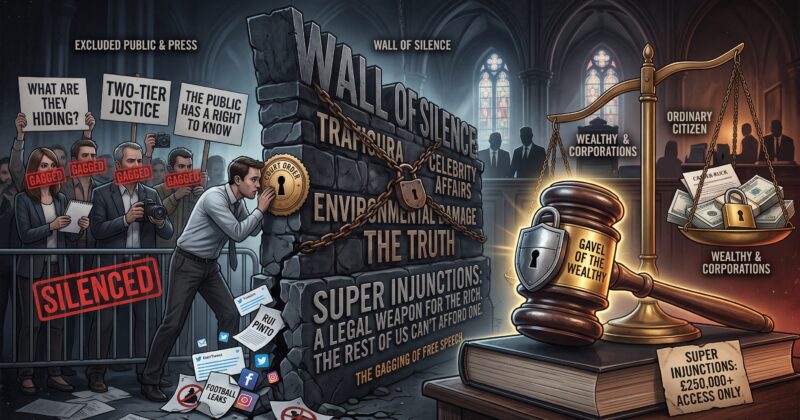
I wrote about super injunctions back in 2011 when a Premier League footballer used one to gag the press about his extramarital affairs. His name was already an open secret — on Twitter, on Google, in every pub conversation in the country — yet legally protected from appearing in British newspapers.
I had questions then. Strong ones. Fifteen years on, I still have them. Because the fundamental problem hasn’t changed.
But let me give you the full picture first, because the Ryan Giggs case — as famous as it became — was not where this story started.
Where It Really Began: Trafigura
The case that should have changed everything happened in 2009, and it had nothing to do with celebrity affairs.
Trafigura, an oil trading company, used a super injunction obtained through lawyers Carter-Ruck to prevent The Guardian from reporting on allegations that the company had dumped toxic waste in the Ivory Coast in 2006 — waste that had severely affected thousands of local people. The injunction was so extreme that The Guardian was banned not just from reporting the story, but from even revealing that an injunction existed. The case appeared in court records only as “RJW and SJW v The Guardian.”
The injunction also attempted to prevent The Guardian from reporting a question tabled in Parliament by MP Paul Farrelly — a direct attempt to gag parliamentary democracy itself. Carter-Ruck eventually backed down, but not before causing national outrage.
Ian Hislop, editor of Private Eye, was furious — and rightly so. His magazine had already published the MP’s question using parliamentary privilege two weeks before Twitter even caught up with the story. On Have I Got News For You, Hislop gave the country a masterclass in why this mattered, describing what he called an “emerging culture of anonymity in which justice is not even seen to be done.” He later called super injunctions a legal “weapon” deployed by the rich and powerful.
He was absolutely right.
The Celebrity Circus
Once the public became aware that super injunctions existed, the celebrity cases followed thick and fast — and these were the ones that captured public attention, even if Trafigura was the more consequential case.
Ryan Giggs obtained an injunction to suppress reporting of his affair with model Imogen Thomas. His name was everywhere on social media. Twitter users were naming him openly. The injunction was, in practical terms, useless — but legally still enforceable in the UK, meaning British newspapers watched on as the rest of the world reported freely.
It took an MP invoking parliamentary privilege in the House of Commons to finally name him publicly. That this was the mechanism required to break a legal order being openly mocked online tells you everything about how disconnected the law had become from reality.
Jeremy Clarkson took out an injunction against his first wife Alex Hall to prevent her writing about their relationship. It reportedly cost him £250,000 to maintain. He eventually lifted it himself, and his reasoning was more honest than most. He said: “Injunctions don’t work. You take out an injunction and immediately news of it and the people involved is in a legal-free world on Twitter and the Internet. It’s pointless. I rue the day I was advised to take one out.”
There was also Andrew Marr — a BBC journalist whose entire career involved holding powerful people to account for their private behaviour — who took out a super injunction in 2008 to hide an extramarital affair. When it was eventually revealed, Hislop was characteristically direct: “As a leading BBC interviewer asking politicians about failures in judgment and failures in their private lives, it was pretty rank of him to have an injunction while working as an active journalist.”
Fred Goodwin, former head of RBS — the man who presided over one of the most catastrophic banking failures in British history — also used parliamentary privilege being invoked to expose his injunction. A man whose decisions cost the taxpayer billions, hiding behind the courts.
The Core Problem
Here is what unites every single one of these cases, and what nobody in Westminster has ever properly addressed.
Super injunctions are exclusively a tool for the wealthy.
The legal costs involved in obtaining one are astronomical. They are not available on legal aid. They exist, in practice, only for the rich and famous. The same people who can afford elite lawyers to find loopholes in speeding offences can afford to buy their privacy through the courts.
An ordinary person facing genuine harassment, a real threat to their reputation, a legitimate need for court protection — cannot access these tools. They simply don’t have £250,000 to spend.
That is a two-tier legal system. It is structural inequality written into law.
And the Trafigura case shows that it isn’t just celebrities protecting affairs. It is corporations suppressing evidence of environmental damage. It is powerful institutions using the courts to hide information that the public has a genuine right to know.
The Verdict in 2026
Has anything changed? Marginally.
There have been reviews, reports, consultations. The Neuberger Report of 2011 acknowledged the concerns. David Cameron called the situation “unsustainable.” And yet the fundamental architecture remains intact. Wealthy individuals and corporations can still use the courts to suppress reporting. The inequality of access has not been addressed.
What has changed is that social media has made injunctions practically unenforceable. The moment one is granted, it is effectively broken within hours online. Which raises the question nobody seems willing to answer directly: what is the point of a legal instrument that can be rendered meaningless by a single viral post?
The honest answer is that super injunctions now serve one purpose: to intimidate. They are not genuinely effective at suppressing information. But they are effective at frightening ordinary people — like Alex Hall, who described receiving the Clarkson injunction as “just terrifying” — into silence. And that, perhaps, is the point.
The Questions I Asked in 2011
I asked why legal protection wasn’t equally available to all. I asked why it took so long to debate this in Parliament. I asked why the Prime Minister and Leader of the Opposition could discuss it on morning television but not in their official capacities.
I’m still waiting for the answers.
Until super injunctions are either abolished or made equally accessible through legal aid, they are not a tool of justice. They are a privilege. And in a country that prides itself on the rule of law, that should be an embarrassment.
Do you think super injunctions should be abolished entirely? Let me know in the comments.