
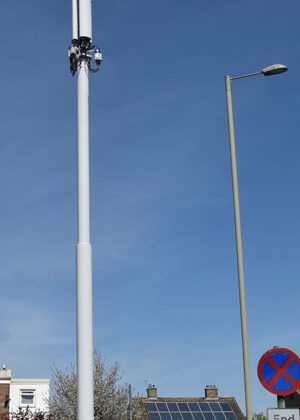
We call them mobile phones, on mobile networks. Worth asking honestly: are they phones, and are they actually mobile? Making a call is nowhere near the main function of a smartphone for most people anymore — it’s a multimedia and communication device first, used for photos, messaging, browsing, notes, reminders, and a personal assistant, with making an actual phone call somewhere near the bottom of that list. And when you do try to use it for that original purpose while actually moving — walking, in a car, on a bus or train — you will hit blackspots and dead zones, reliably, somewhere on almost any regular journey in this country. The word “mobile” is doing a lot of work it hasn’t earned.
Official Coverage Figures and Real Experience Are Two Different Things
Ofcom’s own Connected Nations 2025 report states that 96% of the UK landmass has 4G coverage from at least one operator, with the government’s 95% geographic coverage target already met. On paper, that sounds like the problem’s basically solved. It isn’t, and Ofcom’s own methodology admits why: its coverage data comes primarily from operator modelling — predictions of how a signal should travel from a mast, accounting for hills and buildings — not from direct, on-the-ground measurement. Ofcom states plainly that “reported mobile coverage may not reflect individuals’ real-world experience.”
That gap isn’t small. The River Severn Partnership’s 2025 independent survey — the largest real-world mobile connectivity study of its kind, covering eight counties across England and Wales, using professional surveyors and monitoring equipment fitted to waste collection vehicles for genuinely comprehensive on-street data — found that more than 15% of postcodes across the region failed to receive an adequate signal to even complete a voice call. In some council areas, that figure rose to almost 30%. This is precisely the gap between “coverage exists somewhere in this area” and “you can actually make a phone call while moving through it,” and it’s the exact experience most people would recognise instantly and Ofcom’s headline statistics simply don’t capture.
The divide is sharpest, unsurprisingly, in rural areas: 95% of urban homes get indoor 4G from all four networks, against just 64% of rural ones. Tens of thousands of premises, concentrated in rural Scotland, Wales, and Northern Ireland, are genuine not-spots with no indoor 4G from any operator at all.
Prices Keep Rising. What Are We Actually Getting?
Here’s where the frustration compounds. Mid-contract price rises used to be tied to CPI or RPI plus roughly 3.9% — in 2024, that meant increases of 7.9% to 8.8% depending on the network, with some business contracts rising as much as 18% during the worst inflation years. Ofcom banned inflation-linked rises for new contracts from January 2025, replacing them with fixed pounds-and-pence increases instead — sold as a transparency win, but not remotely a price freeze: EE, Vodafone, Three, and O2 all now apply fixed annual increases of £1.50 to £2.50 a month regardless of what inflation is actually doing, and O2 controversially applied its higher new rate retroactively to existing customers rather than just new sign-ups, a move Ofcom itself criticised for going against the spirit of its own reform.
The industry’s standard justification for these increases is “continued investment in the network.” That’s a reasonable thing to invest in, in principle. But set that justification against the actual coverage data above — real-world voice-call failure rates still running at 15-30% in independently surveyed regions, rural indoor coverage still trailing urban by 31 percentage points — and the honest question is whether that investment is translating into anything close to proportionate improvement for what customers are actually paying more for, year after year.
Has 5G Actually Delivered?
The jump from 3G to 4G was a genuine, tangible upgrade for most people. 4G to 5G has been a much smaller leap in practice, and a geographically limited one — you generally need to be considerably closer to a mast to get any benefit at all, which is precisely why rollout has been so patchy. As of the most recent Ofcom data, outdoor 5G from all four networks reaches just 64% of UK premises, and 5G Standalone — the version that actually delivers 5G’s full speed and reliability benefits, rather than simply running on top of the existing 4G network — is still described by Ofcom itself as merely “continuing to expand,” years after 5G was first marketed to the public as the next great leap. The government’s own target is nationwide standalone 5G coverage only by 2030. That’s not stagnation dressed up as caution. It’s a genuinely slow rollout for a technology that’s been publicly available since 2019.
And WiFi Never Solved This Either
Home and business WiFi has genuinely improved — faster, more reliable, more widely available than it was a decade ago. But there’s no universal, national WiFi network filling the gaps mobile data leaves behind. Instead, the UK has a patchwork: separate WiFi logins for different train operators, different logins again for high street coffee chains, hotel chains, and shopping centres, each requiring its own sign-up, its own terms and conditions, and often its own advertising gauntlet before you get five minutes of actually usable connectivity. There’s no single system that recognises you once and keeps you connected as you move between all of these, the way genuinely joined-up national infrastructure would. It’s an additional fragmented layer sitting on top of an already unreliable mobile network, not a real substitute for it.
Is Anything Actually Coming to Fix This?
Two genuinely different things are in the pipeline, on two very different timescales, and it’s worth being clear about which one might actually matter to your day-to-day experience of blackspots.
6G is real, but it’s a long way off, and it isn’t really about blackspots. The International Telecommunication Union and 3GPP — the bodies that define every mobile generation — have a formal roadmap: technical requirements finalised by the end of 2026, technology proposals submitted from 2029, final specifications by mid-2030, with commercial deployment expected from around 2030 onward. The UK is genuinely part of this, having signed a 2024 joint statement on 6G principles alongside the US, Japan, South Korea, France, Canada, and others. But 6G’s actual design goals are centred on AI-native network architecture, sensing capability, and satellite integration — not primarily on solving the basic coverage gaps this piece has been describing. Even in the best case, it’s the better part of a decade away from reaching ordinary users.
Satellite-to-phone technology is the one actually worth watching, because it’s happening now, in Britain specifically. Vodafone has partnered with AST SpaceMobile — a US satellite company backed by AT&T, Verizon, and Google — specifically to eliminate rural not-spots by connecting ordinary, unmodified smartphones directly to low-Earth-orbit satellites, using Vodafone’s own licensed spectrum rather than requiring any special hardware. As of August 2026, AST SpaceMobile has formally filed plans naming Vodafone as its UK partner, operating under an Ofcom demonstration and trial licence, using a ground station at Goonhilly Downs in Cornwall. It’s still a trial, not a commercial service — no launch date has been confirmed — but the explicit goal, in Vodafone’s own words, is “100% geographic coverage across Europe,” aiming to fill in exactly the gaps this piece has documented, in places where building another mast is either impossible or uneconomical. SpaceX’s rival Starlink Direct-to-Cell system is pursuing the same goal through a different technical approach, already partnered with T-Mobile in the US, and BT has separately partnered with Starlink for broadband, though not yet direct-to-device connectivity in the UK.
The honest caveat: initial versions of this technology, as deployed elsewhere, don’t support full voice or video calls yet — Starlink’s early partnerships have focused on emergency SMS and basic data. So even the most promising near-term fix is likely to start by patching text messages and data in true dead zones, not necessarily restoring your ability to make an actual phone call from the one field with no signal on your usual dog walk. But unlike 6G, this is a genuine, live UK development, not a decade-away standards process — and it’s the first serious technical attempt in years at actually solving the specific “not-spot” problem, rather than just building yet more masts in places where masts have proven uneconomical for two decades running.
Except We’ve Already Seen How This Plays Out
Here’s the part that should temper any optimism about either of the above: the industry has a documented habit of turning “the fix for our own network’s shortcomings” into a new premium tier, rather than simply delivering the fix. This isn’t a cynical prediction. It’s already happening again, this week. VodafoneThree — the newly merged entity from last year’s £15 billion Vodafone-Three merger — has just launched “SuperMobile,” a faster 5G tier explicitly marketed as the answer to Britain’s mobile coverage ranking bottom among G7 nations for both speed and coverage. Accessing it costs £3 to £12 extra a month on top of an existing plan, depending on which tier you’re already on. The company is charging a premium specifically to fix a problem its own existing, standard-rate product hasn’t solved.
This has happened before, almost exactly. When EE launched the UK’s first 5G network in 2019, its own CEO said outright that the company believed “customers will pay a little more for the 5G experience,” and EE charged a 5G premium from day one. Vodafone and Three, by contrast, both launched 5G at no extra cost over their existing 4G pricing that same year, explicitly positioning it as a free upgrade rather than a new revenue line — proof this was always a choice, not a technical necessity. Six years on, the pattern has crept back regardless: even now, VodafoneThree’s baseline 5G is included at no extra cost on eligible plans, but the genuinely improved, higher-speed version — the one actually addressing the coverage complaints — sits behind a new paywall.
There’s no reason to expect satellite-to-phone connectivity or 6G to behave any differently once they mature. The likely pattern, based on everything the industry has done with every previous generational upgrade, is a “basic” tier included as standard specifically to be able to claim the technology is available, with the version that actually delivers a meaningfully better experience — genuinely eliminated not-spots, genuinely faster satellite backup, genuinely reliable calls in dead zones — sold as a premium add-on for as long as the market will bear it, before eventually becoming standard only once enough competitive pressure or regulatory attention forces the issue. Given how long that took with basic mobile signal itself, nobody should assume the wait will be short this time either.
We Moved Fast, Then We Stopped
This is, in the end, a story about the plateau after the sprint. 2G to 3G to 4G delivered real, felt, dramatic improvement in a relatively short space of time, and the industry — and the public — got used to that pace as the expectation. 4G to 5G has delivered a far smaller improvement, far more slowly, requiring infrastructure most of the country still doesn’t have. Meanwhile the price keeps rising, justified by network investment that independent, on-the-ground surveys suggest still leaves a meaningful share of the country unable to reliably make a phone call while simply going about an ordinary day. We built extraordinary technology extremely quickly, and then the pace of genuine improvement essentially stopped, while the cost of access kept climbing regardless. That’s not innovation continuing at a mature, sensible pace. That’s stagnation, with a rising bill attached.