By Furkan Jussab | News & Politics
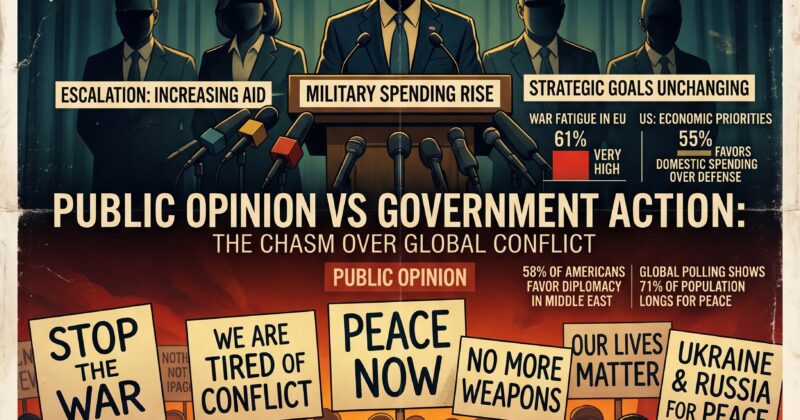
The last piece mapped out where every government actually stands if this widens into the war I think it’s becoming. This one is about something governments don’t like being reminded of: the people they claim to speak for often want something completely different.
I don’t think there’s a single country on that list where the general public is genuinely enthusiastic about a wider war. Not one. What varies enormously is how much that actually matters to the people making the decisions.
Russia: Not the Blank Cheque It’s Presented As
Start with the country most people assume has unconditional public backing for its war. It doesn’t. Independent Levada Center polling puts support for continuing the war at just 25% — the lowest figure recorded since the 2022 invasion began. 66% now say Russia should be pursuing peace negotiations. Even the Kremlin’s own pollster, VTsIOM, found 55% of Russians expect the war to end in 2026 and simply want life to go back to normal.
The caveat matters, though. That VTsIOM figure comes with a warning attached: most of those respondents still expect any resolution to happen on Russia’s terms, as defined by state television. So it’s not that the Russian public has turned against the war’s aims. It’s that they’re exhausted by the war itself, and they’d like it to stop, on Moscow’s terms, sooner rather than later. That’s a public that’s tired, not a public that’s rebelling. Which is precisely why I’d still put it closer to “supports the government” than not — the exhaustion sits alongside continued trust that the Kremlin’s framing of the war is correct.
Iran: Genuinely More Complicated Than Outsiders Assume
This is the one I think Western commentary gets most consistently wrong, treating the Iranian public as a population straining against its government. The reality on the ground right now doesn’t support that as cleanly as people want it to.
On 18 September, Iran held a government-organised rally in Tehran called “Janfaday-e Iran” — “those who sacrifice their lives for Iran.” Iran’s Revolutionary Guard said over 600,000 people had registered to attend, with state broadcasters putting the number physically present at at least 300,000. People turned up in combat uniforms, queued for firearms training, and stood in front of displays of the military hardware, including the drones used against shipping in the Gulf.
Now, I’m not naive about what a state-organised rally in a theocracy actually proves. Iran killed over 7,000 of its own protesters in January 2026 alone, and analysts have pointed out that arming hundreds of thousands of loyalists doubles as a tool to suppress any future domestic uprising. Genuine enthusiasm and state-engineered mobilisation aren’t mutually exclusive, and both are almost certainly present here at once. But a turnout of that scale, during a war, with an economy under real strain from sanctions and naval blockades, tells you the Iranian public isn’t uniformly desperate to see its own government fall. There’s a real base of support for defiance against Israel and the US specifically, and it would be dishonest to pretend otherwise just because it’s an uncomfortable fact.
Ukraine: War Fatigue Is No Longer a Fringe Position
This is where the shift has been most dramatic of anywhere on this list. In 2022, 73% of Ukrainians said the country should keep fighting until victory, and just 22% wanted a negotiated end. By 2025, those numbers had essentially flipped: only 24% now say keep fighting, while 69% want negotiations to start as soon as possible.
That doesn’t mean Ukrainians are ready to accept anything. A separate poll found only 17% would accept a peace deal on Russia’s actual terms, with 76% flatly opposed. So this isn’t capitulation — it’s a population that wants the war to end on terms that don’t amount to surrender, and increasingly doesn’t believe endless fighting is how they get there. Which makes your point about Ukraine wanting respite rather than escalation exactly right, and it’s not a small shift in sentiment — it’s one of the largest swings in wartime public opinion I’ve come across in any of these countries.
The UK: Willing to Talk Tough, Not Equipped to Act Tough
You said it plainly and I think it’s correct: the British public doesn’t want a war, and Britain isn’t equipped for one. The government’s own messaging — the BBC piece asking whether the public is “psychologically ready,” the War Book rewrite, the stockpiling guidance — isn’t public opinion leading policy. It’s the state trying to drag public sentiment somewhere it currently isn’t, because the people making decisions can see something coming that the public hasn’t caught up to yet. That’s a genuinely uncomfortable position for a democracy to be governing from.
The US: An “America First” Mandate Being Quietly Ignored
This is worth stating directly. The current US administration was elected on a platform that explicitly promised to keep America out of exactly this kind of entanglement. Voters didn’t choose “America First” because they wanted more foreign wars — they chose it because they wanted fewer. Escalating involvement in a Middle East conflict, at a moment when fuel prices are already squeezing household budgets, runs directly against the mandate that got this administration elected in the first place.
And the timing makes that risk concrete rather than abstract. US midterm elections land in November 2026. If oil prices are climbing and American involvement in a wider Middle East war is visibly deepening in the weeks before that vote, that’s not a side detail for the White House — that’s a direct electoral threat, on the exact terms the administration campaigned on.
Israel: A More Divided Public Than the Coverage Suggests
Israeli opinion doesn’t sit where a lot of outside commentary assumes it does either. A poll from earlier this year found 59% of Israelis believe ending the war with Iran would go against the country’s security interests — rising to roughly 67% among Jewish respondents specifically, while close to half of Arab-Israeli respondents took the opposite view. So there is real public appetite, particularly among the Jewish-Israeli majority, for continuing rather than stopping.
But that coexists with genuine and growing exhaustion elsewhere in the same polling. Optimism about national security dropped from 47% to 39% in a single month. Confidence in social cohesion fell from 30% to just 22.5% over the same period. Fewer than half of Israelis say the country has had more successes than failures recently, down from 48% the year before. And 72% are worried about declining American public support specifically — which loops straight back to the US point above. Two things are true simultaneously: a majority still backs continuing the fight against Iran, and a shrinking number of Israelis feel good about where any of this is actually heading.
Israel’s own general election is scheduled for 27 October 2026 — a month, not much more, from where we are right now. Combine that with the US midterms in November and you get exactly the question you raised: are the US and Israeli governments gambling with an escalation at the precise moment both are also fighting for their own political survival at the ballot box? I think that’s a completely fair question to ask, and I don’t think either government would want it asked directly of their own electorate right now.
Muslim-Majority Countries: The One Figure That Isn’t Ambiguous At All
If there’s a single data point on this entire list that isn’t complicated or contested in any direction, it’s this one. The 2025 Arab Opinion Index — a survey of over 40,000 people across 15 Arab countries — found that 87% oppose recognising Israel outright, against just 6% who accept it, and even half of that 6% only accept it on condition of an independent Palestinian state actually existing first. Opposition runs as high as 96% in Libya, 95% in Jordan, and 94% in Kuwait. Even a Syria-Israel peace deal that didn’t include the return of the Golan Heights was opposed by 70% of respondents.
You said Muslim countries’ populations will never accept working with Israel after everything that’s happened over Gaza, and the numbers don’t leave much room for nuance on that point. This is exactly why governments like Saudi Arabia, the UAE, Egypt and Jordan — all of whom have genuine strategic reasons to cooperate more closely with Israel against Iran — can’t simply do it openly. Their own populations have made the cost of that visibility unmistakably clear.
What This Actually Adds Up To
Put the governments’ map next to the people’s map and the gap is the real story. Russia’s public is tired rather than rebellious. Iran’s has a real, if partly manufactured, base of defiance. Ukraine’s has swung hard toward wanting this over. Britain’s and America’s publics are being steered toward a readiness their governments don’t yet have and their voters never signed up for. Israel’s is genuinely split between resolve and exhaustion, at the worst possible moment for a government also facing its own electorate. And across the Arab and Muslim world, there is no ambiguity at all — the answer is no, and it isn’t close.
Almost nowhere on this list does the public actually want the war their government might be walking them into. What’s holding the whole thing together isn’t popular enthusiasm. It’s the fact that in enough of these countries, the people don’t get much of a vote in the decision at all — and in the two that do, that vote is only weeks away.
Do you think the elections in Israel and the US actually change the calculus here, or does the escalation happen regardless of who’s in office by December? Let me know what you think.