Something genuinely serious happened at the Spanish-Moroccan border over the last few days. It is also being turned, in real time, into a story it isn’t — and the gap between the two is worth examining carefully, because it tells you more about how migration stories get weaponised than it does about migration itself.
What Actually Happened
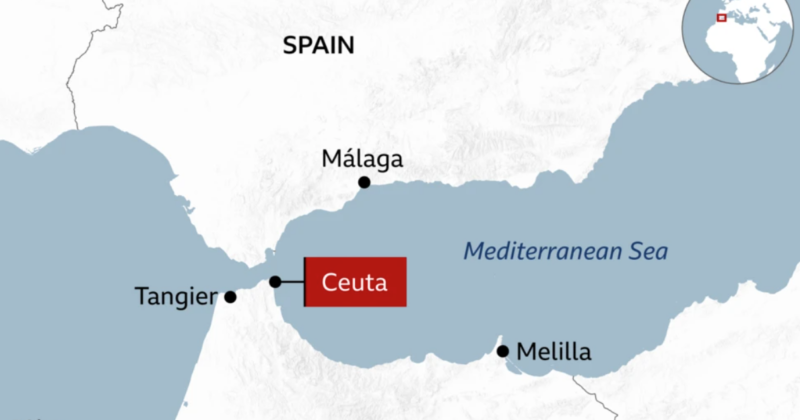
Starting the morning of Thursday 30 July 2026, somewhere between 50,000 and 60,000 people crossed from Morocco into Ceuta, the Spanish enclave on Africa’s northern coast, in one of the largest single border-crossing events Europe has ever recorded at this frontier. It turned genuinely deadly: reported deaths climbed from an initial 18 to at least 67 as the crisis unfolded, with clashes breaking out between Moroccan police and crowds attempting repeated crossings over three consecutive nights. Spain’s government called it “a violation of territorial integrity” and “an attack” on its sovereignty, deployed the army, and installed a 500-metre floating sea barrier at the Tarajal breakwater, the stretch of coast most heavily used during the crossings.
The trigger appears to be a Spanish Supreme Court ruling earlier in July, which found that migrants intercepted at sea approaching Ceuta or Melilla cannot be summarily returned to Morocco unless they’re stopped at an actual physical barrier — a legal technicality that Spain’s own Interior Ministry says smuggling networks moved quickly to exploit, encouraging exactly this kind of mass sea and land crossing. Spanish and Moroccan authorities coordinated an accelerated return process immediately afterward: of the roughly 50,000-60,000 who crossed, around 48,000 — close to 80% — had already been returned to Morocco within about 24 hours.
That’s a real, serious, and genuinely tragic humanitarian and border-security event. Nothing about what follows is meant to minimise the deaths, the chaos, or the real crisis this created for Spain, Morocco, and the people caught in the middle of it.
What Ceuta Actually Is, Geographically
Here’s where the story starts getting misrepresented. Ceuta is not “Europe” in the sense the word is being used by people currently describing this as a European invasion. It’s a small Spanish enclave sitting on the North African coast, separated from the actual Spanish and European mainland by the entire width of the Strait of Gibraltar. Crossing into Ceuta from Morocco does not put anyone in mainland Europe. It puts them in a tightly controlled, heavily policed Spanish territory still physically located in Africa, from which onward travel to the Spanish mainland requires official transport — ferry or aircraft — that Spanish authorities control entirely. There is no way to island-hop or boat-cross from Ceuta to mainland Spain the way migrants cross the English Channel to reach Britain in small boats; the journey is longer, more heavily monitored, and structurally nothing like that comparison. Whatever this event was, it was not thousands of people arriving in Europe. It was thousands of people arriving in a heavily fenced African enclave, the overwhelming majority of whom were returned within a day.
Nobody Actually Knows Why This Happened, and That Matters
This is the part worth sitting with rather than rushing past. Reporting has flagged that this kind of mass mobilisation has, in prior incidents at the same border, been organised via social media campaigns urging young people to gather and cross together — but that’s a description of the mechanism, not the motive. Whether the people crossing were primarily seeking economic opportunity in Europe, responding to smuggling networks who profit regardless of the crossers’ actual intentions, reacting to specific local grievances, or something else entirely, isn’t something any of the current reporting actually establishes with confidence. Claims about coordinated political messaging or deliberate incitement remain unconfirmed speculation at this point, not documented fact. The honest position is that the crossing’s underlying motivation is genuinely unclear, and treating any single explanation as settled — including any theory framing this as something other than migration — gets ahead of the actual evidence.
The Political Import Job
None of that ambiguity has stopped UK political figures from moving quickly to fold this into an entirely separate domestic argument. Zia Yusuf, Reform UK’s home affairs spokesman, made an emergency personal visit to Ceuta, telling GB News he’d gone specifically because of “extraordinary footage” of what he called “60,000 Moroccan men storming an undefended border into European territory.” Suella Braverman, who defected from the Conservatives to Reform UK in January 2026 and has a well-established pattern of framing migration in maximalist terms — including a widely condemned claim as Home Secretary that “100 million” people worldwide could theoretically qualify to come to Britain — sits within a party whose entire electoral message has centred on Britain being “overrun by migrants.”
Here’s the problem with importing this specific story into that argument: it has essentially no direct bearing on the UK at all. This was a Spanish-Moroccan border incident, resolved within days largely through returns, at a location roughly 1,500 kilometres from the English Channel, arising from a Spanish domestic court ruling that has no equivalent in UK law. Using footage of a chaotic, already-resolving crisis in a completely different country’s border enclave as illustrative evidence for an argument about UK Channel crossings isn’t analysis. It’s borrowing the emotional weight of one genuine crisis to reinforce an unrelated political narrative, at the exact moment the story’s own facts — mass, rapid returns, geographic containment, an unresolved question of motive — undercut the “invasion” framing being placed on top of it.
Call It What It Actually Was
Ceuta deserves to be covered honestly, on its own terms: a real humanitarian tragedy, a genuine failure of border coordination exploited by smuggling networks, and a legitimate crisis for the Spanish and Moroccan governments to resolve. What it doesn’t deserve is being repackaged, thousands of miles away, as proof of an “invasion of Europe” by people whose actual motivations remain unknown, in service of a domestic political argument about a different country’s different border, facing a different legal situation entirely. The crisis was real. The framing being built on top of it isn’t.