I’ve owned the Fold 2, the Fold 4, and the Fold 6. I’ve bought my mum the Flip 3, the Flip 5, and the Flip 5 FE every time I’ve upgraded my own. I’m an early adopter by nature, and I’ve been a genuine fan of what Samsung built with foldables — the extra screen space, the format itself, the sheer ambition of putting a crease down the middle of a phone and betting people would want it. Fifteen months ago I added a Huawei Mate XT — the global version, bought in the UAE — as a second phone, purely because nobody else was doing anything as ambitious with three screens instead of two.
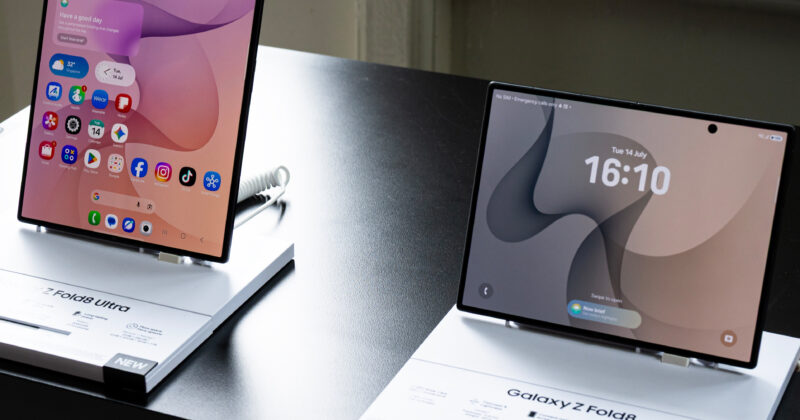
Today, Samsung announced the next generation: the Galaxy Z Fold 8, the Z Fold 8 Ultra, and the Z Flip 8, unveiled at Unpacked in London. And for the first time in this two-year upgrade cycle I’ve run since the Fold 2, I’m not blindly buying it.
What Actually Got Announced
Worth being precise about what’s actually new here, because Samsung has restructured its own lineup in a genuinely confusing way. The Z Fold 8 Ultra is, despite the name, the direct successor to last year’s Fold 7 — same tall book-style shape, a thinner profile, triple cameras, and Samsung’s first use of silicon-carbon battery chemistry, taking the battery from the Fold 7’s fairly weak 4,400mAh up to 5,000mAh without adding bulk. It’s a solid, incremental refinement. It is not a reinvention.
The genuinely new device is the Z Fold 8 — no “Ultra” — which abandons the tall, narrow book shape entirely for a shorter, wider “passport-style” form factor: a 5.5-inch outer screen that behaves like a normal phone, opening into a near-square 7.6-inch tablet display. That’s a real design swing, and credit where it’s due, it’s the first meaningfully different thing Samsung has done with the format in years.
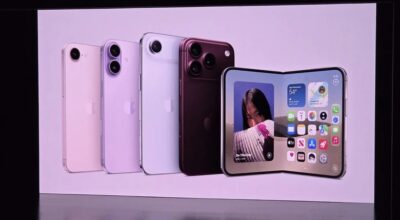
But it’s worth asking why now, and the answer isn’t a mystery — it’s a supply chain fact. Samsung Display, Samsung’s own display-manufacturing arm, is the confirmed exclusive supplier of the foldable OLED panels going into Apple’s first folding iPhone, under a three-year exclusivity deal, with mass production already under way for a launch expected around September 2026. Samsung’s phone division has known exactly what Apple’s foldable looks like, and roughly when it’s arriving, for a long time — because Samsung’s own factories are the ones building the screens. Industry reporting has also linked the “Ultra” naming on the tall Fold specifically to lining up alongside Apple’s expected “iPhone Ultra” branding. Put those two things together and the passport-style Fold 8 stops looking like a burst of inspiration and starts looking like exactly what you’d do if you already knew, months in advance, what shape your biggest rival’s first foldable was going to be, and wanted your own version on shelves first. That’s a real commercial advantage. It just isn’t the same thing as innovation.
Why I Actually Did the Research This Time
Here’s my honest problem with Samsung over the last few cycles. For years they had this category almost entirely to themselves in the West — Google’s folding Pixel was experimental and never caught on, and most of the strongest Chinese competition simply wasn’t sold outside China. That’s not innovation-driven dominance. That’s dominance by default, and it showed: Samsung’s annual Fold updates became genuinely incremental, refining rather than pushing, because there was no real commercial pressure forcing them to do otherwise.
That pressure exists now, and it’s obvious the moment you actually look at what Chinese manufacturers are shipping globally rather than just domestically. Oppo’s Find N6 has all but eliminated the crease that’s plagued every folding screen since the format began — genuinely close to invisible, both to the eye and under a finger — and it’s built real software around that hardware too: a three-screen swipe gesture for moving between open apps that feels more like a proper multitasking system than a novelty. Honor’s Magic V6 is thinner and lighter than anything Samsung makes, while matching the same Snapdragon silicon and memory configurations. Vivo goes further still on its own multitasking approach, with a persistent sidebar that keeps several apps genuinely running and switchable at once, rather than the freeze-and-reload approach most Android skins default to — and Vivo does sell globally, it’s simply chosen not to bring this specific generation of the X Fold outside China yet.
Battery is where the gap is starkest. The Fold 8 Ultra’s jump from the Fold 7’s 4,400mAh to 5,000mAh is a genuine improvement, and Samsung is rightly proud of it. But Oppo’s Find N6 ships with a 6,000mAh cell as standard. Honor’s Magic V6 goes up to 6,850mAh in its standard configuration and 7,150mAh on the 1TB model. Vivo’s X Fold6 tops even that at roughly 6,900–7,000mAh, the largest yet in a book-style foldable. Samsung isn’t just behind here, it’s not close.
I ended up choosing the Honor Magic V6 specifically, not because it’s the single best of the three on paper, but because of how it handles running apps in the background. This is worth explaining properly rather than just crediting Samsung: the reason Oppo and several other Chinese Android skins have historically felt weaker on notifications isn’t a software design failure exactly, it’s that Chinese manufacturers have tended to run unusually aggressive battery-management systems that kill background apps quickly to preserve battery life, which means notifications and app state get lost more often than they should. Honor appears to have tuned this more sensibly than most of its Chinese peers, which is why it feels closest to what One UI does well, without actually being One UI. Samsung’s genuine remaining edge is software polish and update longevity — that’s real, and it’s worth something. It’s just not enough on its own to justify the price gap anymore.
Which makes it genuinely surprising to me that Samsung will almost certainly still outsell all three of these Chinese rivals combined in most Western markets this year. That’s not a hardware verdict. That’s a brand-recognition and retail-availability verdict, and it’s worth being honest about the difference.
The Trifold Question
This is where it gets more interesting, because the format’s real experimentation right now isn’t happening in the book-style category at all.
Samsung did release a tri-fold this year — the Galaxy Z TriFold, a genuine three-panel, dual-hinge device with a 10-inch inner display, launched in South Korea in December 2025 and the US shortly after. It sold out almost immediately at every restock, at $2,899, with resale prices on the secondary market climbing as high as $4,400. And then, three months later, Samsung discontinued it entirely — citing its status as a deliberately limited “super-premium” showcase device rather than a mass-market product, despite demand that clearly justified more than a three-month run. For a company worried about looking slow next to Huawei’s trifold, quietly killing off the one genuinely bold product it shipped this year, right after proving people wanted it, is a strange call.
It leaves Huawei’s Mate XT Ultimate as the only trifold with any real staying power on the market — which is exactly the device I already own, minus full Google services outside China. And Huawei isn’t finished: industry tipsters have Huawei’s third-generation trifold, likely the Mate XT 2, pencilled in for launch around September 2026, continuing the same roughly annual cadence that’s produced two significant leaps already.
Honor is the one worth watching most closely here, though, and not by coincidence. Honor was spun off from Huawei into a separate company in 2020, but it continues to draw heavily on Huawei-originated engineering and R&D, which is exactly how a comparatively young standalone brand has managed to compete toe-to-toe with Samsung on hinge and display engineering within a few short years. Honor is widely rumoured to be preparing its own wide-format and trifold devices for very late this year or early 2026, and given that inherited engineering pedigree, I’d expect an Honor trifold to land closer to Huawei’s execution than anyone else attempting the format — genuinely competitive on day one, rather than a first-generation experiment the way Samsung’s TriFold or Xiaomi’s upcoming effort likely will be. Xiaomi’s own Mix TriFold, meanwhile, is reportedly certified and on track for a Q3 2026 launch, and Tecno has already shown a trifold concept, the Phantom Ultimate G, at MWC 2026. Between Huawei’s head start and imminent third generation, Honor’s inherited expertise, Samsung’s abandoned but clearly viable attempt, and Xiaomi’s arrival, the trifold looks less like a gimmick and more like the format’s actual next battleground — book-style folds are maturing into a solved problem, and the real innovation race has already moved one screen further.
A Word for the Company That Got There First
Before any of this, it’s worth giving real credit to Microsoft, because the passport-style shape Samsung is only now shipping, and the multi-screen ambition the whole industry is chasing, was something Microsoft actually built back in 2020 with the Surface Duo — and in one specific respect, built better than anyone has since. Rather than one folding glass panel, the Duo used two separate 5.6-inch screens joined by a genuine 360-degree hinge, with hair-thin custom wiring routing power and data between them, letting the device fold flat backwards into a closed, passport-sized slab, open flush as a small tablet, or hold at any angle in between as a tent or a book. That’s a range of motion no folding-glass hinge has matched since, for the simple reason that a bendable screen physically can’t rotate a full 360 degrees the way two rigid panels joined by a mechanical hinge can. The Duo’s actual failure was everything around that hinge — underpowered chips, unreliable software, a price that didn’t match the spec sheet — not the core idea. Samsung, Oppo, Honor, and Vivo are all, in their own way, still chasing a worse version of the flexibility Microsoft had solved five years ago with a hinge design a folding screen still can’t replicate.
Where This Leaves Me
For now, the Honor Magic V6 replaces the Fold 6 as my daily phone — better hardware, lower price, and software close enough to Samsung’s that I don’t feel like I’m giving anything up. But my two-yearly cycle is already looking past that: with Xiaomi’s global trifold ambitions taking shape and Huawei’s Mate XT Ultimate showing what full-size tablet folding can actually do, my Mate XT’s likely replacement next year isn’t another Samsung. It’s whichever trifold finally ships globally with full Google services attached. Samsung had an eight-year head start on that future and just walked away from its own best shot at it.