By Furkan Jussab | News & Politics
I turn 46 this week, and in all that time I haven’t seen anything like what’s happening now. Not during the Cold War years I was a child in, not through 9/11, and not even through Covid, when the advice was about staying home rather than stocking up.
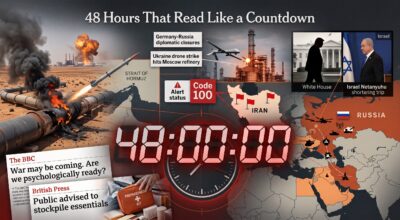
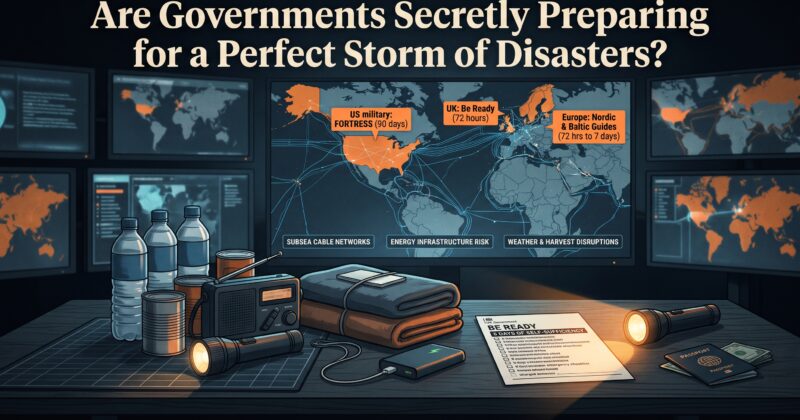
This past fortnight the UK government has told households to keep bottled water, tinned food, torches, blankets, a radio and charged power banks in the house. Across the Atlantic, the Pentagon has a programme called FORTRESS. And when I started looking at who else was doing something similar, the list kept growing.
So I want to ask the question plainly. These warnings are not coming from one country with one worry. They are arriving from many governments, at the same time, from different directions. What do they know, or fear, that we are not being told in so many words?
What Governments Are Actually Saying
Let me start with what’s on the record, because some of it is more nuanced than the headlines.
The UK. The government’s “Be Ready” campaign launched on 22 October. It asks households to be self-sufficient for three days: roughly three litres of drinking water per person per day, non-perishable food that needs no cooking, a torch, batteries, a wind-up or battery radio, a charged power bank, first-aid supplies, medication, cash, copies of important documents, and blankets and warm clothing. It was backed by a written ministerial statement to Parliament, and the Defence Secretary, Wes Streeting, said the public must prepare for supply-chain disruption caused by “hostile state actors or terrorists,” while adding he wants people to be “alert but not alarmed.” In a separate piece in the Telegraph he warned that adversaries could have the strength and war economy to attack by 2030, which he described as roughly 1,000 days to prepare. His words: “To prevent the worst, we have to prepare for it.”
Two things are worth being fair about. Britain has published household preparedness guidance since May 2024, so this is not entirely out of nowhere. And the campaign was reportedly planned under the previous prime minister, with Andy Burnham delaying the launch over concerns it would seem too pessimistic. Even the British Retail Consortium has warned that “panic buying is quite easy to generate.” But I also note that the shelves of tinned beans, bottled water and wind-up radios were reported to have sold out within days of the announcement. People are not reading it as routine.
The US. FORTRESS stands for Federal Operations for Resilience, Troop Resources, Energy, Supply, and Survivability. Defense Secretary Pete Hegseth unveiled it in his 30 September “State of the Force” address, and a follow-up memo in early October set up a dedicated programme office. The detail that matters is the requirement reported on 25 October from internal planning documents: every major military installation in the continental US should be able to keep essential operations running for at least 90 days without outside help. That means power, water, fuel and communications, plus strategic reserves of munitions, fuel and medical supplies, and at least two supply routes for anything critical.
I should be precise here because it’s been shared online as though the US government is telling citizens to prepare for three months without power and internet. It isn’t. This is a military resilience programme for bases, and the Pentagon hasn’t named a threat. A senior official said around 500 bases are still being assessed and full compliance could take decades. But the stated logic is blunt: spokesman Sean Parnell said losing electricity means losing communications, water, logistics and command. And the threat context the reporting points to is a 2024 joint advisory warning that Chinese state-backed hackers known as Volt Typhoon could disrupt essential services in a future conflict. You do not plan for 90 days of isolation unless someone has told you it is plausible.
Europe. This is where it really adds up, because the advice differs country by country but runs in the same direction:
- Sweden: a brochure, “In case of crisis or war,” sent to every household. A week’s supplies is the guidance, and it says an armed attack “cannot be ruled out.”
- Finland: 72 hours, covering power cuts, communications failure and cyber disruption.
- Denmark: 3 days, citing cyberattacks, sabotage and extreme weather.
- Estonia: at least a week, and being able to cope without electricity, water or heating.
- Germany: ideally ten days of supplies, three at the very minimum, citing peacetime crises like animal disease and major industrial accidents, as well as war scenarios.
- Poland: 3 days, plus knowing where your nearest shelter is.
- France: 72 hours, with the guide updated in August 2026.
- Netherlands: 72 hours, plus about €70 in cash per adult.
- Ireland: a “Be Emergency Ready” campaign published in August 2026.
- Switzerland: a new security strategy approved in September.
- The EU itself: its Preparedness Strategy asks every household to be self-sufficient for 72 hours.
I can’t claim to have checked every country in the world. But the pattern across the Nordics, the Baltics, central Europe and the UK is unmistakable.
Why Now? The Perfect Storm
The official reasons given are a mixture: severe weather, cyberattacks, supply-chain failure, hostile states. I think they’re all true, and I think there is more behind them. Here are the threads I keep coming back to.
1. Wars involving nuclear powers, with no sign of ending
The war between Russia and Ukraine continues, with Ukraine now striking Moscow’s energy infrastructure and Russia holding the line. The war between the US/Israel and Iran has shut the Strait of Hormuz for months and drawn in the Houthis, who announced a blockade on Saudi Arabia on 20 July and have since hit Riyadh directly. In both, a nuclear-armed power is directly involved. Big talks have been held, ceasefires have been proposed, and neither war is closer to ending. Governments planning for the worst cases are planning for a long one.
2. A record El Niño
NOAA’s Climate Prediction Center gave an 81% chance, in its 9 July update, of a very strong El Niño during October to December, and a 97% chance it persists into early spring 2027. The WMO has warned that temperature anomalies in key equatorial regions could exceed 2°C before the winter peak. The US lab model runs were described as at least competitive with the strongest events of the past century. The effects are well known: drier monsoon conditions in Southeast Asia, flooding in East Africa, dangerous heat in North America, and disruption to rice, corn and cocoa harvests. In 1997-98, the last comparable event, one study found roughly 292,000 hectares of rice and corn were destroyed in the Philippines alone. A bad year for crops lands on top of wars that have already pushed up fuel and fertiliser costs.
3. The infrastructure the modern world quietly depends on
This is the thread I find most worrying, and the least discussed.
Subsea cables. About 99% of international internet traffic travels by submarine cable, according to the ITU. The Red Sea is a narrow corridor through which an estimated 15 to 17% of global traffic passes, and a commonly quoted estimate says around 90% of Europe-Asia communications. That latter number is contested: a subsea cable firm argues it’s overstated and the Red Sea “isn’t the internet’s jugular.” But even critics concede that cable damage there “does cause measurable disruption,” as the 2024 cuts showed when a ship sunk by a Houthi missile dragged its anchor across three cables. The Strait of Hormuz also carries cables, and Iran’s IRGC threatened them as recently as 21 October, although analysts say the Gulf carries only a fraction of global bandwidth and cutting it wouldn’t switch off the world’s internet. For India, though, about 60% of traffic runs on the Gulf-linked route. The Luzon Strait, between the Philippines and Taiwan, is a major crossing for Asia-Pacific cables in an earthquake-prone area, and the 2006 Hengchun earthquake showed how a single event there can cripple connectivity across Asia. I haven’t been able to verify a precise percentage for it. An El Niño winter makes a storm or landslide in that area more, not less, plausible.
Oil. Saudi Arabia’s workaround for Hormuz was to export from the Red Sea. Roughly 80% of its 4 million barrels a day of crude exports have been going through the Bab al-Mandeb, according to Kpler data. With the Houthis now announcing a blockade on Saudi shipping, the fallback is to divert north towards the Suez Canal and the SUMED pipeline, which is less efficient for supplying Asia. When I looked for the exact share of global oil that SUMED carries, I couldn’t find a reliable figure, so I’ll leave that number out rather than guess.
Gas. One thing to correct from my own notes: Nord Stream carried gas, not oil. German prosecutors allege the September 2022 sabotage was ordered by Ukrainian state authorities and carried out by a team led by a former Ukrainian officer, who denies involvement. A trial has reportedly opened in Germany this month. Whatever the outcome, the point is that Europe’s energy system has already been physically attacked once. And Europe now depends on a web of other lines: Langeled and Europipe bringing Norwegian gas to Britain and Germany, Algerian gas to Spain and Italy, TurkStream and Blue Stream from Russia to Turkey, and the Dolphin pipeline carrying Qatari gas to the UAE and Oman. A hit on any of them lands on an energy market that is already fractured by the wars above.
4. A cost-of-living squeeze that has become unbearable
Everything above feeds one thing: prices. And people have started to react. The recent headlines read “Europe’s Gen Z takes to the streets in wave of anger” and “Gen Z are leading the European protests. Here’s why they’re angry,” and the grievances named are jobs, housing, corruption and the cost of living. It echoes the Gen Z-led protests that erupted across Morocco, Togo and elsewhere in 2025. The common feature is young people who feel locked out through no fault of their own, who’ve seen their prospects deteriorate while everything gets dearer, and who are now losing patience.
5. Immigration tension, with a political edge
On top of that, the West is going through a rightward political shift and a push to control borders. The campaigning group HOPE not hate, which is openly critical of the movement, counted at least 251 anti-migrant events across 77 locations in just the second half of 2025, many of them outside hotels housing asylum seekers, from Epping to Ballymena, with riots in Dublin in October. Whatever you think about the politics, a society under economic strain that is also splitting over immigration is a society where unrest is easier to ignite.
And probably more
There are other pressures that sit alongside these. September’s air traffic control failure was the third major one in three years, and it came with a stark reminder from Ryanair that “no lessons have been learned.” Cyber threats to utilities are real enough that the Pentagon cites them. The electricity demand from AI data centres is climbing on grids that are already stretched. Any one of these is manageable. The worry is when they arrive together.
So What Are They Preparing Us For?
Here’s where I try to be honest about both possibilities.
The reassuring reading is that this is multi-hazard resilience planning, dressed up in a new campaign. Britain has had this guidance for two years, the wording is deliberately calm, “alert but not alarmed,” and the official reasons include storms, wildfires and IT failures, which have genuinely disrupted people’s lives. The campaign was reportedly drawn up before the latest escalations and held back for fear of sounding alarmist. Governments are also finally doing what the Nordics have done for decades.
The less comfortable reading is that governments are quietly telling us to prepare for a world where the lights, the water and the internet might go off for days, and have chosen the gentlest possible language to do it. Notice that no minister is saying “war is coming.” They are saying “hostile state actors,” “severe weather,” “cyber attacks,” and “be ready.” The Pentagon doesn’t name a threat either. When governments in the UK, the US, Germany, the Nordics and the Baltics all start telling people to stock up within weeks of each other, while two nuclear powers are at war, the oil is under threat and the cables are being threatened, the simplest explanation may be that they’ve all read the same risk assessments and none wants to be the one to say what’s in them.
I don’t think anybody is planning mass lockdowns or anarchy, and I wouldn’t want anyone to read this and panic. Please don’t empty the shelves. What I do think is that when governments in a dozen countries move in the same direction simultaneously, that is information. They are not stockpiling for fun. And if the only message we get is “keep a torch and some beans in the cupboard,” then the least we can do is ask what they are actually worried about.
I’ll keep doing exactly that.
Have you bought anything yet, or does this feel like overreaction? Let me know in the comments.