By Furkan Jussab | News & Politics
I’ve been tracking the pattern for a while now — the argument I made a few pieces back that we’re already living through a World War 3 that nobody in power wants to actually call by that name, because naming it means having to do something about it. I didn’t expect to be writing a follow-up quite this soon, and I didn’t expect the follow-up to read like it does. But here we are, and the last 48 hours have given me more evidence than I wanted.
Let me walk through what’s actually happened, because a lot of it landed within a single weekend, and taken individually each story is alarming. Taken together, they start to look less like a series of unrelated crises and more like a pattern accelerating in real time.
The Trigger: Saudi Arabia’s Only Remaining Lifeline Gets Hit
Start with the oil. The Strait of Hormuz — the chokepoint through which around a fifth of the world’s oil supply normally passes — has effectively been shut down by the ongoing Iran war for months now. That’s not a new development, it’s been the backdrop to everything else. What Saudi Arabia has had, as a workaround, is the East-West pipeline: a route that lets it move crude across the country to the Red Sea and bypass Hormuz entirely. It’s the pressure valve that’s kept Saudi oil exports functioning while the strait itself is closed off.
That pipeline was attacked. And then, on top of it, the Houthis carried out their first-ever missile attack directly on Riyadh itself — not a Saudi military target near the Yemeni border, the capital. Two escalations, days apart, both hitting the parts of Saudi infrastructure and security that were supposed to be the buffer against exactly this kind of situation.
The practical effect is what I described in blunt terms: Saudi Arabia currently has oil it cannot reliably get out. Hormuz has been the blocked route for months. Now the bypass route has been damaged too. That’s not a minor supply hiccup — that’s the two main arteries for one of the world’s largest oil exporters both compromised in the same window. It strongly suggests the Yemen war, which has simmered for years, is about to escalate rather than wind down, because Saudi Arabia now has a direct, urgent reason to respond forcefully to a capital-city attack rather than treat this as a border skirmish.
The Signals From Washington and Tel Aviv
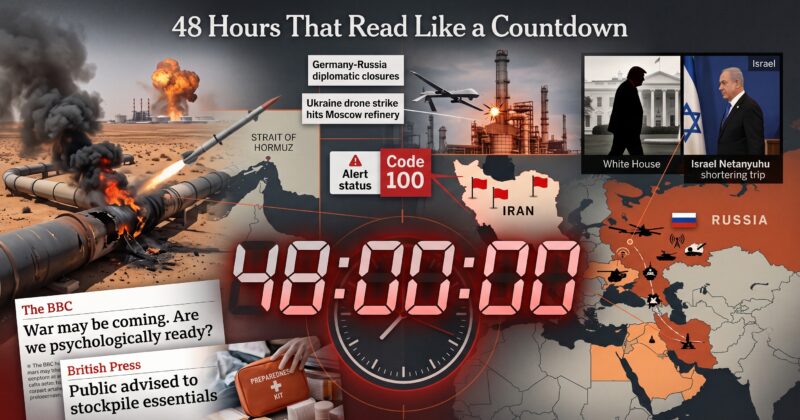
Here’s where it stops being containable to one region. Trump cut short his stay and returned to the White House a day early, with no official explanation given. Netanyahu shortened his own trip to the US around the same window. Iran raised its internal security posture to what’s being described as “Code 100” — its highest alert level, on the expectation of an imminent attack. US embassies across the region issued fresh security warnings to citizens.
None of these movements, on their own, prove anything. Officials cut trips short for all sorts of reasons and governments raise alert levels as a matter of caution rather than certainty. But when you get all four in the same 48-hour window — a US president’s unexplained early return, an Israeli PM’s shortened visit, Iran’s highest alert status, and US embassy warnings — that’s not noise. That’s the kind of clustering that tends to precede something, not follow it.
Britain Is Quietly Preparing Its Own Public for War
This is the part I found most telling, because it’s not happening in the Middle East at all — it’s happening here, in the UK’s own media and government messaging. The BBC ran a piece with the headline “War may be coming. Are we psychologically ready?” That is not a headline a national broadcaster runs lightly, and it’s not the kind of framing that appears in isolation. It sits alongside a broader push in recent months to get the British public thinking about preparedness — guidance on stockpiling essentials, discussion of rewriting the UK’s War Book (the Cabinet Office’s playbook for transitioning the machinery of government onto a war footing), and public comments from senior military figures, including former NATO deputy supreme commander Sir Richard Shirreff, about the need to take the threat of a wider war seriously rather than treat it as a remote hypothetical.
You don’t see governments and broadcasters gently preparing the public’s psychology for something that isn’t at least being planned for as a real possibility. That’s not scaremongering on my part — that’s reading what’s already been published and asking why it’s being published now.
The Russia-Ukraine Front Escalated in Parallel
At the same time, on a completely separate front, things moved too. I’d originally understood this as Germany closing its embassy in Russia, and I want to correct that because it matters to get this right: it wasn’t the main embassies on either side. Germany closed its consulate in Bonn along with the Russian House cultural centre in Berlin at the start of September. Russia responded in kind by closing the German consulate in St Petersburg and Goethe-Institut cultural centres by around September 18th. Both countries’ actual embassies — in Moscow and in Berlin — remain open. It’s a real and deliberate diplomatic escalation, just one step below the more dramatic story of embassies shutting entirely.
Still, a tit-for-tat closure of consulates and cultural institutions between two major powers is not a routine diplomatic spat. It’s the kind of move that happens when a relationship is actively deteriorating, not one that’s merely tense.
And then, overnight between the 19th and 20th of September, Ukraine carried out one of its largest drone strikes on Moscow to date, hitting a Gazprom Neft oil refinery. The timing wasn’t incidental — it landed during Russia’s parliamentary elections, and it came in direct defiance of a Trump-brokered truce on striking energy infrastructure that both sides had nominally agreed to. Whatever the truce was worth, Ukraine’s message with this strike was that it isn’t holding, at least not where Ukraine is concerned.
Why This Matters as a Pattern, Not Just a News Day
Individually, any one of these stories could be filed under “regional tension, nothing new.” Together, in the same 48-hour window, they stop looking like coincidence: Saudi Arabia’s two oil export routes both compromised within days of each other, Yemen’s war primed to escalate as a result, US and Israeli leadership making unexplained early returns, Iran at its highest alert level, US embassies warning their citizens, the UK’s own national broadcaster openly asking whether the public is psychologically ready for war, and — on an entirely separate front — Germany and Russia trading diplomatic closures while Ukraine hits Moscow’s energy infrastructure directly during a truce meant to prevent exactly that.
This is the thing I was trying to describe in the earlier piece. We don’t currently have a World War 3 in the sense of a single declared, unified conflict with clear sides. What we have is a set of overlapping, mutually reinforcing conflicts — Iran and its regional proxies against Saudi Arabia, Israel and the US; Russia against Ukraine and by extension NATO — that are each escalating on their own timelines, in the same stretch of days, while the institutions meant to warn the public are starting to say so out loud.
I don’t think anyone gets to decide the moment a war becomes “official.” That’s not how it’s worked historically — it tends to be named after the fact, once the scale of it is undeniable. But when a national broadcaster is asking if the public is psychologically prepared, when governments are rewriting their war playbooks and pushing stockpiling advice, when multiple fronts escalate in the same 48 hours rather than in isolation — that’s not me reaching for a dramatic conclusion. That’s just describing what’s actually in front of us.
I have two follow-up pieces I want to get into next, building directly on this. More on those shortly.
Where do you think this goes from here? Let me know in the comments.