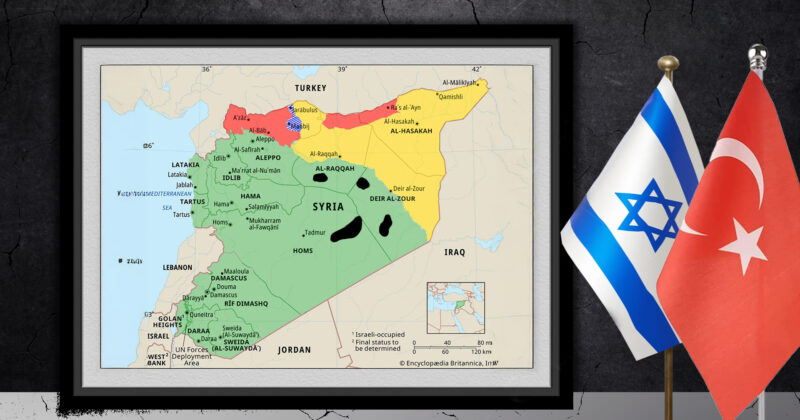
On 18 August 2026, Israeli jets flew deep into northern Syria and dropped eight bombs on the runway and hangars of the Abu al-Duhur airbase in Idlib province — roughly 45 miles from the Turkish border. The timing wasn’t incidental: a Turkish military delegation had visited the same airfield just hours earlier to inspect plans for rebuilding it. Israel confirmed within a day that the strike was specifically intended to prevent Turkey from establishing a military presence there. This is not a one-off. It’s the second time in eighteen months Israel has bombed a Syrian airbase specifically because Turkey was showing interest in it — the first was the T4 base in Homs province, struck in April 2025 under near-identical circumstances. A pattern like that isn’t an accident. It’s a deliberate, repeated policy.
Why Israel Is Doing This
Since Bashar al-Assad’s regime fell in December 2024, Syria’s new government under Ahmed al-Sharaa has leaned heavily on Turkey to rebuild its shattered military and state institutions — training, infrastructure, diplomatic backing. Israel has watched that relationship with genuine alarm, not because Syria’s rebuilding army poses much of a near-term threat on its own (reduced to roughly 150,000 personnel with limited conventional capability after Israel’s own campaign of strikes), but because of what a serious Turkish military presence in Syria could eventually mean: radar coverage, air defence systems, and aircraft that could meaningfully restrict Israel’s ability to operate freely over Syrian airspace, something it currently does almost without challenge. Analysts describe Israel’s underlying goal bluntly — not just containing Syria, but pre-emptively blocking Turkey from ever establishing the infrastructure that would let it project power that close to Israel’s own borders.
The Rhetoric Is Real, and It’s Coming From Senior Officials
This isn’t fringe commentary. Former Israeli Prime Minister Naftali Bennett has said openly that Turkey, backed by Qatar, is “replacing Iran as Israel’s major strategic threat.” Former Defence Minister Yoav Gallant has suggested Western states reconsider arms sales to Turkey — despite Turkey being a NATO member in good standing. Foreign Minister Israel Katz has directly accused Erdoğan of “sacrificing his country’s economic interests” over support for Hamas, following Turkey’s complete trade embargo on Israel in 2024. On the American side, sympathetic voices have gone even further: a scholar at a US Department of War-linked think tank wrote in the Wall Street Journal in March urging NATO to reconsider Turkey’s membership altogether, arguing Ankara is “a headache for its allies.” That’s not background noise. That’s a serious, if not yet official, current running through parts of the Israeli and American national security conversation: Turkey as the next long-term adversary, discussed in explicitly Iran-shaped terms.
Turkey Isn’t Standing Still Either
Turkey holds NATO’s second-largest standing army. Earlier this month, it signed a new mutual defence pact with Pakistan and Saudi Arabia — a genuinely significant development, given Pakistan’s nuclear arsenal, that expands Turkey’s alliance network well beyond NATO’s own structure. Ankara has become one of Syrian President al-Sharaa’s principal international backers, training his forces and rebuilding state capacity, precisely the relationship Israel keeps bombing to disrupt. Turkey’s own Foreign Minister has condemned the latest strike and called for “stronger international action.” None of that is Turkey backing down.
The NATO Question, Tested Once Already This Year
Here’s where the analysis needs real precision, because there’s already a live precedent from earlier this year showing exactly how this plays out in practice, not just in theory. During the broader US-Israel-Iran war, in March 2026, an Iranian ballistic missile was launched toward Turkish airspace and intercepted by NATO’s own missile defence systems — the first time in the alliance’s history a member state was directly drawn into a live Middle Eastern conflict this way. It was, by any reasonable reading, exactly the kind of scenario Article 5 exists for. And NATO’s own Secretary General, Mark Rutte, was unambiguous: “Nobody’s talking about Article 5.” US Defence Secretary Pete Hegseth said there was “no sense” it would trigger the clause. Turkey itself didn’t even formally invoke Article 4, the lesser consultation mechanism that would ordinarily precede any move toward collective defence.
That precedent matters enormously for how seriously to take the Israel-Turkey scenario. It shows that even when a missile was genuinely inbound toward NATO territory, from a state NATO members were actively at war with, the alliance’s actual instinct was restraint, not escalation — a strong signal that the bar for actually invoking collective defence is far higher in practice than the treaty’s text alone suggests. If a live missile threat from Iran didn’t trigger Article 5, a war Turkey would have to actively choose to enter against Israel — a country most NATO members don’t want to be seen fighting either — looks considerably less automatic than the “NATO obligated to intervene” framing implies.
Where the Real Danger Actually Sits
The genuine risk here isn’t a clean, sudden NATO-triggering event. It’s the slower, message-based escalation already visible in the pattern: Israel repeatedly striking exactly the targets that signal “we will not tolerate Turkish military infrastructure this close to our border,” and Turkey absorbing each strike diplomatically for now, while building out alternative alliances (Pakistan, Saudi Arabia) that reduce its own reliance on NATO solidarity it may increasingly doubt would actually materialise if push came to shove. That’s a genuinely dangerous dynamic in its own right — not because it guarantees a NATO-triggering war, but because it strips away exactly the alliance guarantees that were supposed to make this kind of great-power-adjacent brinkmanship less likely in the first place.
And there’s a further complication rarely mentioned in coverage of this: this strike has put Netanyahu visibly at odds with Trump specifically. Trump’s own envoy for Syria, Tom Barrack, publicly called the strike “an unnecessary escalation that does not advance regional stability.” Trump has invested real political capital in his relationship with both Erdoğan and Syria’s new government as a genuine foreign policy achievement, and Israel’s strike directly undercut that, reportedly frustrating senior White House officials. That’s a genuinely unusual position for Israel to be in: not just escalating with Turkey, but doing so in a way its own primary benefactor is visibly unhappy about.
The Honest Assessment
This is not, right now, a war. It’s a pattern of deliberate, repeated Israeli strikes aimed specifically at preventing Turkish military expansion in Syria, paired with increasingly explicit “Turkey is the next Iran” framing from senior Israeli figures, sitting on top of a NATO alliance that has already shown, under real pressure this year, that it’s far more reluctant to invoke collective defence than the treaty’s language alone would suggest. The danger isn’t an accidental NATO war by Wednesday. It’s a slow erosion of exactly the guardrails — alliance trust, mutual restraint, a credible collective defence threat — that were supposed to make an Israel-Turkey war unthinkable in the first place, at a moment when both sides are quietly building the alternative alliances and doctrine that would let them fight one anyway, if it ever actually comes to that.