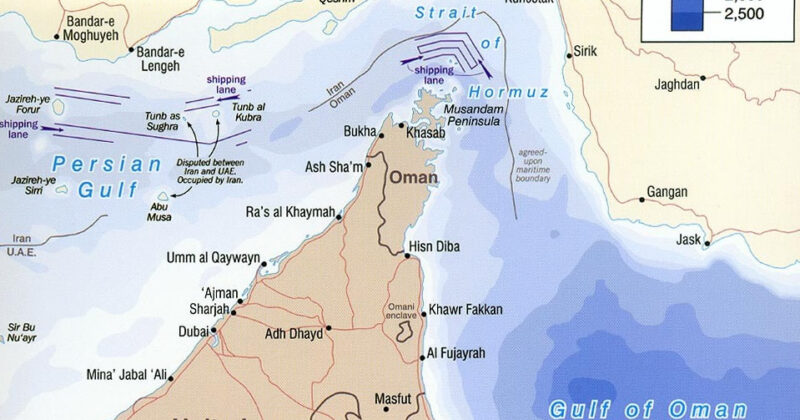
This week, President Trump posted a map on Truth Social, without comment, labelling the Strait of Hormuz “NEW U.S. Territory.” It’s the latest escalation in a pattern running for months — threats to rename it the “Strait of America” or the “Strait of Trump,” a floated 20% transit fee under a self-appointed “Guardian of the Hormuz Strait” role, and now a literal territorial claim over water that sits entirely within Iranian and Omani sovereign waters. This piece asks the question seriously: if this stopped being a social media post and became an actual, enforced policy, what does the world that follows look like?
The Legal Reality Nobody Can Actually Enforce
Start with what’s settled, because it shapes everything that follows: there is no legal mechanism by which the US can simply annex a strait between two other sovereign nations. The Strait of Hormuz sits within Iranian and Omani territorial waters under UNCLOS, governed by the transit passage regime this site has covered before — a regime that guarantees passage rights, not ownership rights, to any nation. The Stimson Doctrine’s non-recognition principle, now customary international law, means territory acquired by force or coercion is automatically void in the eyes of the international community — precisely the doctrine invoked against Russia’s Crimea annexation and Iraq’s invasion of Kuwait. No amount of US insistence changes the underlying legal status. What changes is whether anyone with the power to contest it actually does.
Oman: The Actual Aggrieved Party, and the Quietest One
Everyone’s attention goes to Iran in this scenario, but Oman is the other sovereign owner of this water, and Oman’s reaction matters more than most analysis gives it credit for. Oman has spent decades building a careful, deliberately neutral diplomatic identity — mediating between Iran and the West precisely because it maintains relationships with both. Trump has already threatened to bomb Oman if it “interferes” with US efforts over the strait, an extraordinary threat against a country that has never been anything but a US security partner. A formal territorial claim over water Oman half-owns would force Muscat into an impossible position: publicly acquiescing to a claim that guts its own sovereignty, or publicly breaking with Washington in a way that ends forty years of careful positioning overnight. My own read is that Oman does neither cleanly — it protests through the Gulf Cooperation Council and the Arab League rather than bilaterally, buying time while quietly courting Chinese and Indian security guarantees as a hedge, permanently damaging trust in the US security relationship even if the claim is eventually walked back.
Saudi Arabia and the UAE: Forced Off the Fence
This is where the scenario gets genuinely dangerous for US strategic interests longer-term. Saudi Arabia and the UAE have spent the last decade deliberately hedging — buying US weapons while opening economic and diplomatic doors to China, refusing to fully choose a side. A unilateral US claim over a strait carrying the bulk of Gulf oil exports removes the hedge. Both nations would face intense domestic and regional pressure to either accept a genuinely humiliating precedent — a foreign power claiming sovereignty over water their own economies depend on — or actively work against it. My assessment: they wouldn’t join Iran militarily, but they would very plausibly accelerate exactly the kind of dedollarization and alternative-currency oil settlement talks with China that Riyadh has already been quietly exploring since 2022, converting a security crisis into a much slower-moving but more consequential shift in how Gulf oil gets priced and paid for globally.
China: The Power With the Most to Gain From Restraint
China imports more oil through Hormuz than any other nation on Earth. A US claim over the strait puts a meaningful share of Chinese energy security directly under American control, at least in theory. Beijing’s actual response, based on its established pattern in the South China Sea disputes, wouldn’t be immediate military confrontation — China doesn’t need to fight this claim, it needs to make it unenforceable. Expect Chinese naval escorts for its own tankers transiting the strait, framed explicitly as freedom-of-navigation operations rather than confrontation, daring the US Navy to actually intercept a Chinese-flagged vessel and trigger a superpower incident neither side actually wants. Expect accelerated Chinese investment in Pakistan’s Gwadar port and pipeline infrastructure explicitly marketed as a Hormuz bypass. The long game for Beijing is using this exact crisis as the proof point for why the world needs alternatives to a chokepoint any single power can suddenly claim — which serves China’s Belt and Road infrastructure strategy perfectly, regardless of how the immediate standoff resolves.
Russia: The Opportunist, Not the Principal Actor
Russia has no direct stake in Hormuz, but every interest in a scenario that isolates the US diplomatically and drives up global oil prices — Moscow’s own primary revenue source. Expect vocal UN Security Council condemnation, a veto-proof resolution deliberately introduced to force an embarrassing US veto on record, and quiet material support to Iran’s response — intelligence sharing, air defence systems, diplomatic cover — without direct Russian military involvement. Russia benefits from chaos here without needing to spend anything to create it.
Europe: Split Between Principle and Dependence
This is where the scenario creates the most acute pain for traditional US alliance structures. The EU imports meaningful volumes of Gulf energy and has, since 2022, been desperately diversifying away from Russian supply specifically toward Gulf alternatives — making Hormuz’s stability a genuine European economic security interest, not an abstract one. My expectation: France and Germany lead a European statement condemning the claim as a violation of international law (consistent with their own stated principles on Ukraine), while simultaneously and quietly lobbying Washington through back channels not to actually enforce it, because European governments cannot afford a genuine shipping crisis on top of everything else currently straining European energy markets. The UK’s position is the most awkward of all — caught between its “special relationship” instinct to avoid direct confrontation with Washington and its own stated commitment to UNCLOS and the rules-based order it invokes constantly elsewhere, likely producing the diplomatic equivalent of mumbling.
Japan and South Korea: Economically Exposed, Politically Silent
Both nations depend overwhelmingly on Gulf oil transiting exactly this water, and both have deep, foundational security dependencies on the US military umbrella that make open criticism of Washington extraordinarily difficult regardless of the economic stakes. Expect muted, carefully-worded statements about “the importance of freedom of navigation” that avoid naming the US directly, while both governments scramble behind the scenes to secure alternative supply guarantees and accelerate strategic petroleum reserve drawdowns to buy time.
The Iran Reaction, and Why It’s Not the Main Event
Iran’s response is the most predictable part of this entire scenario and, in some ways, the least strategically important, because Iran has limited capacity to change the outcome on its own — its real leverage comes from how the rest of the world responds around it, not from unilateral escalation. Expect the mining and harassment tactics already seen throughout 2026’s broader Hormuz crisis to intensify, framed explicitly as defence of sovereign territory rather than aggression, giving Tehran a genuinely stronger legal and rhetorical position internationally than it’s had at any point in this entire conflict — because for the first time, Iran would be the party with UNCLOS, the Stimson Doctrine, and basically the entire international legal community agreeing with it.
The Actual Economic Mechanism That Ends This Fastest
Here’s the detail that matters more than any government’s official statement: Lloyd’s of London and the wider marine insurance market don’t wait for the UN to rule on legality. The moment a chokepoint carrying roughly a fifth of the world’s oil and LNG becomes the subject of a live territorial dispute between two nuclear-adjacent military postures, war-risk premiums spike immediately and dramatically, insurers begin excluding the route entirely regardless of naval escort, and commercial shipping volume collapses — not because any single tanker is sunk, but because the insurance math stops working. This has already happened repeatedly in smaller form throughout 2026’s Hormuz crisis. A formal US claim would make it comprehensive and immediate. That’s the pressure point that forces a resolution faster than any court ruling or UN resolution ever could: not international law, but Lloyd’s underwriters refusing to write a policy.
Where This Actually Leads
Put all of this together, and the most likely trajectory isn’t sustained US territorial control — it’s a several-week global shipping and insurance crisis, a genuinely serious rupture in trust with Gulf partners the US has spent decades cultivating, a propaganda gift to China and Russia that accelerates dedollarization conversations already underway, and an eventual, quiet American climbdown dressed up as a negotiated “security partnership” or “joint patrol authority” rather than an outright claim — allowing Washington to claim some symbolic win while retreating from the legally indefensible position it started from. The lasting damage wouldn’t be territorial. It would be to exactly the kind of alliance trust and rules-based credibility the US has spent the post-war era building, traded for a Truth Social post and a map with no legal standing at all.
This we